


Gekantete Spiralfedern werden aufgrund ihrer stabilen Vorspannung, ihrer hohen Lebensdauer und ihrer kompakten Bauweise häufig in der Luft- und Raumfahrt, der Medizintechnik und der Halbleiterindustrie eingesetzt. Dieser Artikel erläutert gängige Anwendungen, Leistungsvorteile, Materialoptionen und bietet einen detaillierten Vergleich mit herkömmlichen Federn.

Die moderne Industrie stößt immer wieder an die Grenzen der Präzision, Zuverlässigkeit und Miniaturisierung, sind herkömmliche Federlösungen oft nicht mehr ausreichend. Dies gilt insbesondere für Luft- und Raumfahrt, medizinische Geräte und Halbleiterausrüstung, in denen ein Versagen keine Option ist und die Toleranzen extrem eng sind.
Kantige Schraubenfedern-auch bekannt als schräge Schraubenfedern oder Federn mit konstanter Kraft-haben sich zu einer bevorzugten Lösung in diesen Hochleistungsbereichen entwickelt. Im Gegensatz zu herkömmlichen Druck- oder Zugfedern bieten schräge Schraubenfedern stabile Vorspannkraft, ausgezeichnete Ermüdungsfestigkeit und hervorragende Leistung bei begrenztem Platzangebot.
Dieser Artikel befasst sich mit der Häufigste Anwendungen von schrägen Schraubenfedern in drei kritischen Branchen und erklären, warum sie ausgewählt wurden, wie sie funktionieren und was Konstrukteure beachten sollten.
A Schrägzugfeder wird durch eine Reihe von Windungen gebildet, die relativ zur Federachse abgewinkelt sind. Diese Geometrie ermöglicht ein sanftes Einfedern der Feder bei nahezu konstanter Kraft über einen großen Arbeitsbereich.
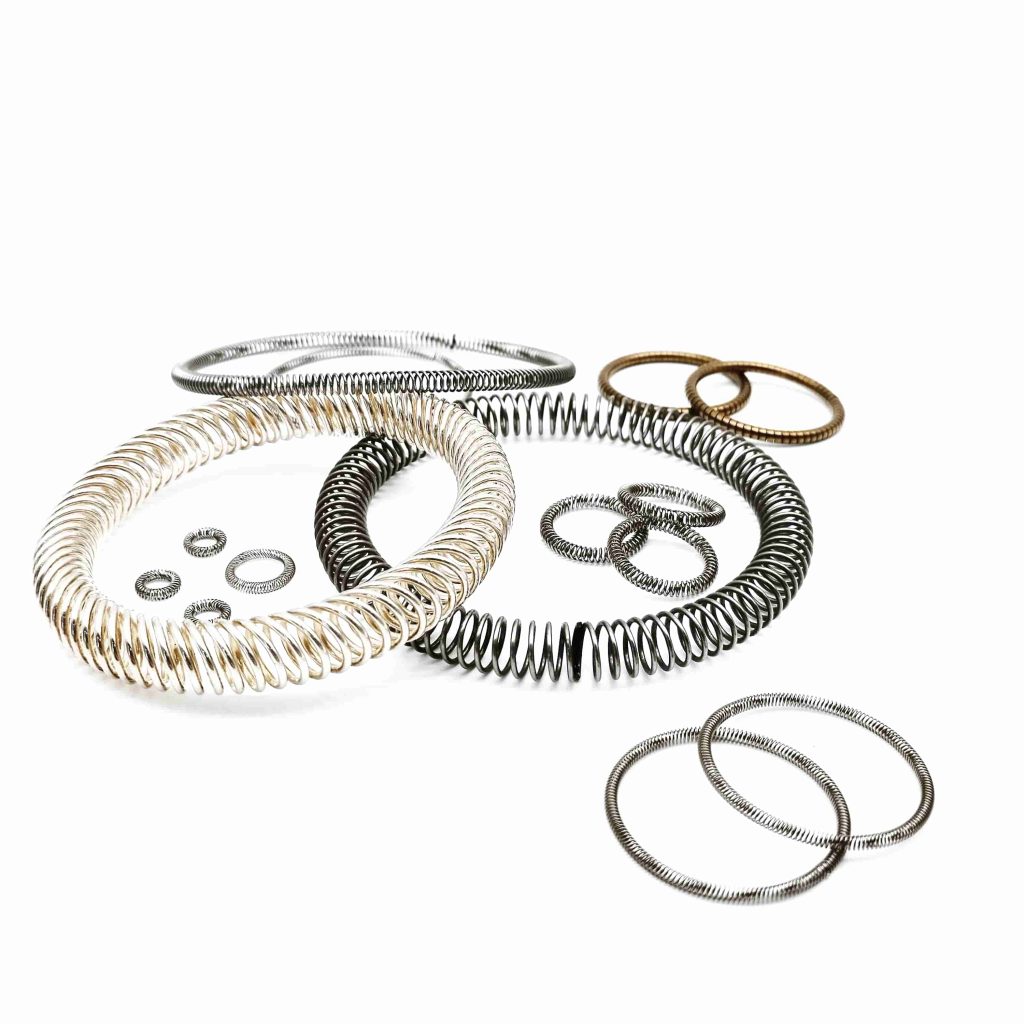
Aufgrund dieser Eigenschaften eignen sich geneigte Schraubenfedern besonders für kritische Baugruppen und hochzuverlässige Systeme.
Bevor Sie sich mit branchenspezifischen Anwendungen befassen, sollten Sie Folgendes wissen warum geneigte Spiralfedern besser sind als herkömmliche Federtypen in anspruchsvollen Umgebungen.
| Leistungsfaktor | Kantige Spiralfedern | Druckfedern |
|---|---|---|
| Vorspannung bei Durchbiegung Null | Ja | Nein |
| Kraft-Stabilität | Ausgezeichnet | Mäßig |
| Ermüdung Leben | Sehr hoch | Mittel-Hoch |
| Vibrationsbeständigkeit | Ausgezeichnet | Begrenzt |
| Weltraum-Effizienz | Hoch | Mäßig |
| Präzisionskontrolle | Ausgezeichnet | Begrenzt |
Die Luft- und Raumfahrtindustrie verlangt absolute Zuverlässigkeit unter extremen Bedingungen, Dazu gehören Temperaturschwankungen, Vibrationen, Druckänderungen und eine lange Lebensdauer.
Gekantete Schraubenfedern werden häufig verwendet in für die Luft- und Raumfahrt geeignete elektrische Steckverbinder um eine konstante Kontaktkraft aufrechtzuerhalten.
Warum sie verwendet werden:
Typische Komponenten:
Gekantete Schraubenfedern funktionieren wie Halteelemente in Baugruppen der Luft- und Raumfahrt, die häufig die traditionellen Sicherungsringe ersetzen.
Vorteile:
Elektromagnetische Störungen sind ein großes Problem bei Luft- und Raumfahrtsystemen.
Gekantete Spiralfedern für die EMI-Abschirmung:
Medizinische Geräte erfordern Präzision, Sauberkeit, Wiederholbarkeit und Biokompatibilität. Gekantete Spiralfedern erfüllen diese Anforderungen besonders gut.
Bei Geräten wie implantierbaren Sensoren und Diagnosegeräten ist der Platz extrem begrenzt.
Vorteile:
Gekantete Spiralfedern werden verwendet in:
Warum medizinische Designer sie bevorzugen:
Bei Patientenüberwachungs- und Bildgebungssystemen ist ein zuverlässiger elektrischer Kontakt unerlässlich.
Die wichtigsten Vorteile:
Anforderungen der Halbleiterfertigung extreme Präzision, Sauberkeit und Prozessstabilität. Selbst mikroskopisch kleine Unregelmäßigkeiten können zu Ertragsverlusten führen.
Gekantete Spiralfedern werden verwendet, um bei der Positionierung der Wafer eine kontrollierte Kraft aufzubringen.
Warum sie kritisch sind:
Halbleiterwerkzeuge arbeiten oft im Vakuum oder in kontrollierten Atmosphären.
Vorteile der kantigen Schraubenfeder:
Hochfrequenzprozesse erfordern eine robuste EMI-Abschirmung.
Gekantete Spiralfedern bieten:
Die Materialauswahl ist entscheidend für die Leistung und die Einhaltung der Vorschriften.
| Material Typ | Wichtige Eigenschaften | Typische Verwendung in der Industrie |
|---|---|---|
| Rostfreier Stahl 316 | Korrosionsbeständig, biokompatibel | Medizin, Luft- und Raumfahrt |
| Rostfreier Stahl 302/304 | Hohe Festigkeit, gute Ermüdungsfestigkeit | Allgemeine Industrie |
| Beryllium-Kupfer | Ausgezeichnete Leitfähigkeit | EMI-Abschirmung |
| Nickel-Basis-Legierungen | Hochtemperaturbeständigkeit | Halbleiter |
Kraft (N)
│
│ ──────────────── Kantige Spiralfeder
│ /
│ /
│ / Druckfeder
│ /
│___/________________________ Deflection
Das Wichtigste zum Mitnehmen:
Gekantete Schraubenfedern sorgen für einen stabilere Kraft über die Auslenkung, was für Präzisionsgeräte unerlässlich ist.
Unser Präzisions-Schraubenfedern in Schräglage sind so konzipiert, dass sie eine konstante Vorspannkraft, eine außergewöhnliche Ermüdungslebensdauer und eine zuverlässige Leistung in den anspruchsvollsten Umgebungen bieten. Hergestellt aus hochwertigem Edelstahl und Speziallegierungen, sind diese Federn ideal für Steckverbinder für die Luft- und Raumfahrt, medizinische Geräte und Halbleiterfertigungsanlagen.
Das einzigartige Design der abgewinkelten Spule gewährleistet stabile Kraftabgabe bei minimaler Durchbiegung, Dadurch eignen sie sich perfekt für Anwendungen, die einen präzisen Halt, einen elektrischen Kontakt oder eine EMI-Abschirmung erfordern. Im Vergleich zu herkömmlichen Druckfedern bieten schräge Schraubenfedern eine höhere Vibrationsfestigkeit, eine längere Lebensdauer und eine bessere Leistung in kompakten Baugruppen.
Unsere kantigen Spiralfedern sind in verschiedenen Durchmessern, Drahtgrößen und Materialoptionen erhältlich und können so auf strenge Industrienormen und anwendungsspezifische Anforderungen zugeschnitten werden.
Über Luft- und Raumfahrt, Medizintechnik und Halbleiterindustrie, sind geneigte Schraubenfedern zu einer zuverlässigen Lösung für Ingenieure geworden, die eine Präzision, Langlebigkeit und Zuverlässigkeit. Ihre Fähigkeit, eine gleichbleibende Vorspannung zu gewährleisten, rauen Umgebungen zu widerstehen und Millionen von Zyklen zu überstehen, macht sie zu einer wesentlichen Komponente bei der Entwicklung moderner Geräte.
Für Anwendungen, bei denen die Leistung nicht beeinträchtigt werden darf, schräge Schraubenfedern bieten einen klaren Vorteil gegenüber herkömmlichen Federtechnologien.