


Learn how to select the right canted coil spring or slant coil springs for your application. This guide covers load requirements, materials, dimensions, environments, and common use cases to ensure optimal performance and reliability.
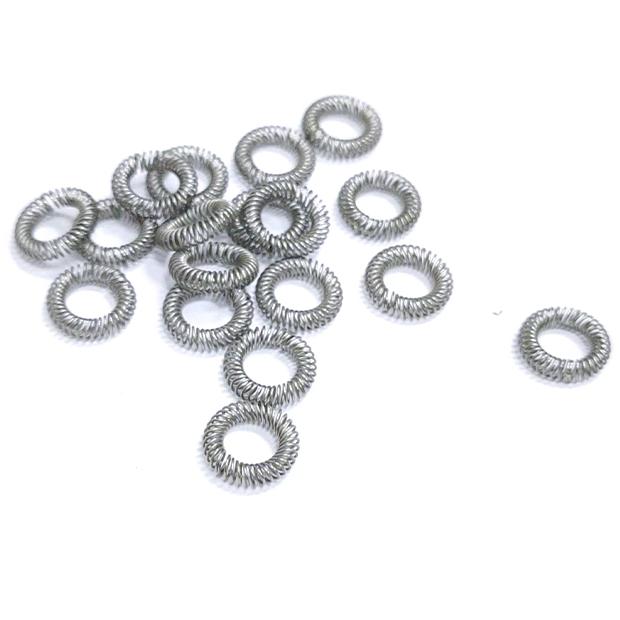
コイルスプリング are widely used in high-performance applications where consistent force, electrical conductivity, or long service life is required. However, selecting the right canted coil spring is not simply a matter of size—it requires a clear understanding of mechanical requirements, operating conditions, and application goals.
This guide walks you through the key factors to consider when choosing a canted coil spring, helping you optimize performance, reliability, and cost for your specific application.
A canted coil spring is a type of precision spring made from coiled wire with each coil “canted” or angled relative to the spring axis. This unique geometry allows the spring to deliver:
Canted coil springs are commonly used for electrical contacts, EMI/RFI shielding, sealing, latching, and mechanical retention.
Choosing the wrong canted coil spring can lead to:
Correct spring selection ensures long-term reliability and consistent performance under real-world operating conditions.
The first step is to determine how much force the spring must deliver throughout its working deflection. Canted coil springs can be designed for:
Understanding both minimum and maximum force requirements is critical.
Clearly defining the load type helps narrow down the optimal spring design.
Measure the available space for compression, expansion, or radial deflection. Canted coil springs are especially valuable in applications with limited space but large deflection requirements.
Always design the spring to operate within its recommended deflection range to avoid permanent deformation or reduced service life.
Material choice directly affects performance, durability, and environmental resistance.
例えば、こうだ:
Consider both operating and peak temperatures. High temperatures can reduce spring force or accelerate material fatigue.
If the spring will be exposed to moisture, chemicals, or salt spray, corrosion-resistant materials or coatings are essential.
Applications involving vibration require springs with excellent fatigue resistance and stable force output.
For electrical contact or grounding applications, material conductivity and contact force must be carefully balanced to ensure low contact resistance.
Canted coil springs are widely used in EMI shielding due to their ability to maintain continuous metal-to-metal contact.
Key considerations include:
Ensure proper fit within grooves, housings, or channels. Tolerances are critical to prevent over-compression or instability.
Canted coil springs can be installed in:
Proper groove design directly affects spring performance and longevity.
Some applications require millions of cycles with minimal force variation. High-cycle applications demand optimized wire geometry and fatigue-resistant materials.
Long-life spring designs reduce downtime and total cost of ownership, especially in critical systems.
Ignoring temperature, corrosion, or vibration often leads to premature failure.
Force characteristics and material properties are just as important as dimensions.
Exceeding the spring’s design limits significantly shortens service life.
Custom or application-specific designs often deliver better performance than off-the-shelf options.
Testing under real operating conditions validates assumptions and prevents costly redesigns.
Providing detailed specifications helps manufacturers recommend the most suitable spring solution.
Selecting the right canted coil spring requires a comprehensive understanding of force requirements, deflection, materials, environment, and application goals. By carefully evaluating these factors, you can ensure optimal performance, long service life, and reliable operation in even the most demanding applications.
A properly selected canted coil spring is not just a component—it is a critical contributor to system reliability and efficiency.
For more detailed info.,please email to: sale01@handaspring.com