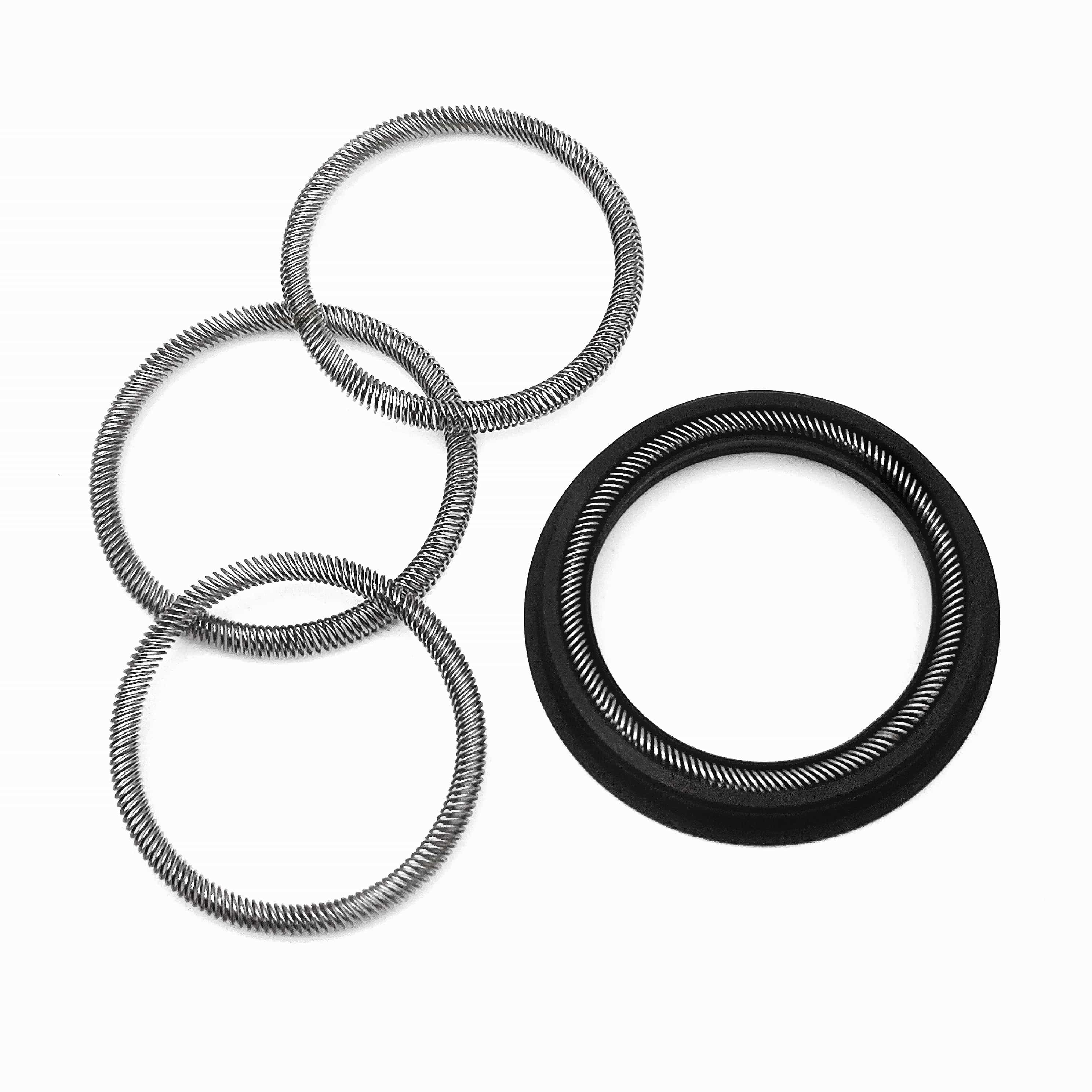
Canted coil springs deliver near-constant force across a wide deflection range. Learn how their unique geometry, mechanics, and materials outperform traditional springs in demanding applications.
In many mechanical and electromechanical systems, maintaining a stable and predictable force throughout movement is critical. Traditional compression or extension springs often produce a rapidly increasing or decreasing load as they deflect, which can lead to inconsistent performance, excessive wear, or premature failure of mating components. This limitation has driven engineers to seek alternative spring technologies that offer smoother, more controlled force behavior.
コイルスプリング have emerged as a preferred solution in applications requiring nearly constant force over a wide deflection range. Their distinctive coil geometry fundamentally changes how load is generated and distributed during compression. As a result, canted coil springs are widely used in electrical connectors, EMI shielding, latching mechanisms, medical devices, aerospace assemblies, and high-cycle industrial systems.
This article explains why canted coil springs provide constant force, focusing on their geometry, mechanical behavior, material characteristics, and real-world performance advantages.
Canted coil springs are helical springs made from round or shaped wire, but unlike conventional springs, their coils are intentionally angled—or “canted”—relative to the spring axis.

Key characteristics of canted coil springs include:
This unique structure is the foundation for the constant-force behavior that distinguishes canted coil springs from traditional designs.
To understand why canted coil springs behave differently, it is helpful to first examine how conventional springs generate force.
In a standard compression spring:
This behavior is often undesirable in applications requiring gentle contact force or consistent electrical conductivity.
Traditional springs often lead to:
These challenges highlight the need for a spring design capable of maintaining stable force over movement—an area where canted coil springs excel.
The defining feature of canted coil springs is their coil angle, which fundamentally alters how the spring responds to compression.
In canted coil springs:
This rolling contact reduces the effective spring rate change as deflection increases, allowing force to remain relatively constant.
Unlike compression springs where coils compress axially, canted coil springs experience a combination of:
This multi-mode deformation absorbs deflection without a steep increase in load.
The constant-force behavior of canted coil springs can be explained through several interacting mechanical principles.
As the spring is compressed:
This prevents sudden increases in stiffness.
The angled geometry introduces controlled friction between adjacent coils. This friction:
While excessive friction is undesirable in many designs, the controlled friction in canted coil springs is a functional advantage.
Because load is distributed along the coil length:
This contributes to stable force output throughout the spring’s service life.
The table below compares typical force-deflection characteristics:
| Spring Type | Force Change Over Deflection | Load Stability |
|---|---|---|
| Compression Spring | Rapid, linear increase | Low |
| Extension Spring | Rapid increase after preload | Low |
| 傾斜コイルスプリング | Minimal change over wide range | High |
This comparison explains why canted coil springs are often chosen for precision applications.
One of the most valuable attributes of canted coil springs is their ability to operate over a wide deflection range without loss of function.
Wide deflection capability allows for:
Canted coil springs maintain consistent force even as system dimensions change.
Canted coil springs are designed for high-cycle applications, often exceeding hundreds of thousands—or even millions—of cycles without significant force degradation.
This makes them ideal for:
While geometry drives the primary behavior, material selection plays a supporting role in force stability.
| 素材 | Key Benefit | Typical Applications |
|---|---|---|
| ステンレス鋼 | 耐食性 | Industrial, medical |
| ベリリウム銅 | Electrical conductivity | Electrical contacts |
| Elgiloy / MP35N | High fatigue strength | 航空宇宙 |
| Inconel / Hastelloy | High-temperature stability | Semiconductor equipment |
The right material ensures that canted coil springs maintain consistent force under environmental stress.
Achieving constant force is not only a design challenge but also a manufacturing one.
Critical manufacturing factors include:
High-precision CNC coiling equipment is typically required to produce reliable canted coil springs.
The constant-force behavior of canted coil springs enables performance improvements across many industries.
In EMI shielding applications:
Canted coil springs are often preferred over fingerstock for this reason.
For latching and locking systems:
Another reason canted coil springs provide superior force control is their design flexibility.
Engineers can fine-tune:
This flexibility allows canted coil springs to be optimized for specific force targets without compromising deflection capability.
The ability of canted coil springs to provide constant force over a wide deflection range is the result of:
Together, these factors create a spring that behaves predictably, resists fatigue, and adapts to real-world conditions.
For applications where force stability is critical, コイルスプリング offer a clear advantage over traditional spring designs. Their unique geometry enables near-constant load across wide deflection ranges, reducing sensitivity to tolerances, wear, and environmental changes.
Whether used in electrical connectors, EMI shielding systems, or mechanical retention assemblies, canted coil springs improve reliability, extend service life, and enhance overall system performance. As engineering demands continue to increase, canted coil springs remain a proven solution for delivering consistent force where it matters most.
For more info.,please email to : sale01@handaspring.com