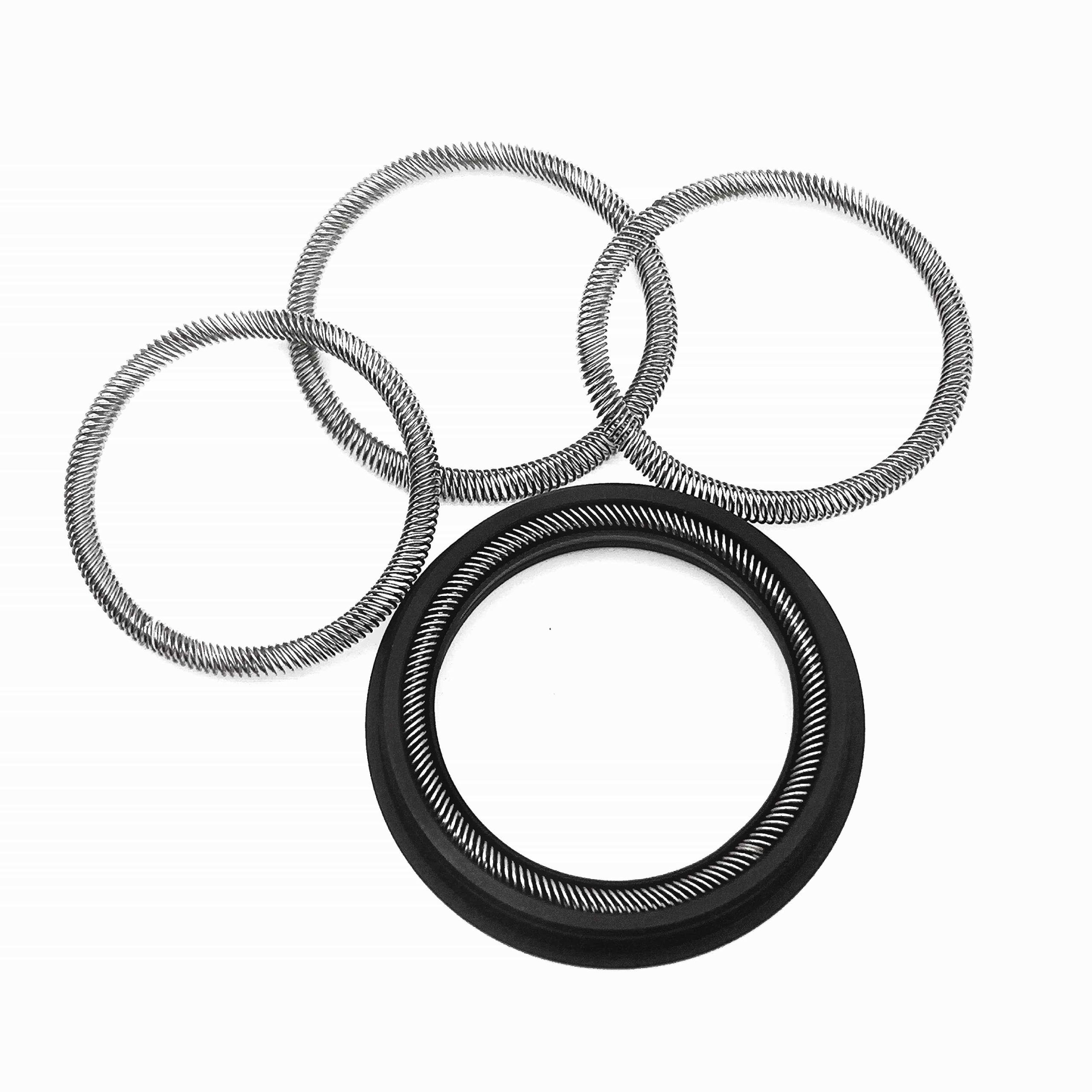
Discover why canted coil springs offer superior sealing performance through consistent contact force, tolerance compensation, and long-term reliability in demanding applications.
In many industrial and high-reliability applications, sealing performance is not only about preventing leakage—it is also about maintaining consistent contact, compensating for tolerances, and ensuring long-term reliability under harsh operating conditions. Engineers across industries increasingly choose 캔트 코일 스프링 as a critical sealing component because of their unique mechanical behavior and proven performance advantages.

This article explains why canted coil springs provide excellent sealing performance, from their structural design and force characteristics to their ability to adapt to real-world operating conditions. By understanding the engineering principles behind canted coil springs, designers and buyers can make more informed decisions for sealing-critical applications.
A canted coil spring is a helical spring in which each coil is angled relative to the spring axis rather than being perpendicular, as in traditional compression springs. This angled geometry allows the spring to deliver nearly constant force over a wide range of deflection.
Unlike elastomer seals or conventional metal springs, canted coil springs are often used as metal sealing elements, providing both mechanical compliance and reliable contact force. Their structure enables them to function as sealing springs, electrical contacts, or EMI shielding elements in demanding environments.
Effective sealing depends heavily on stable and uniform contact force. If the force is too low, gaps form and leakage occurs. If the force is too high, excessive wear, deformation, or assembly damage may result.
Canted coil springs excel in sealing applications because they provide:
This balance makes canted coil springs especially suitable for precision sealing applications where traditional solutions struggle.
| Engineering Factor | How It Affects Sealing Performance | Advantage of Canted Coil Springs |
|---|---|---|
| Angled Coil Geometry | Determines how force is applied to the sealing interface | Provides near-constant contact force over a wide deflection range |
| Contact Force Stability | Inconsistent force leads to gaps and leakage | Maintains stable sealing pressure despite dimensional changes |
| Tolerance Compensation | Manufacturing tolerances can reduce sealing effectiveness | Automatically compensates for groove depth and width variations |
| Metal-to-Metal Sealing Capability | Elastomers may fail at high temperature or in vacuum | Enables reliable metal-to-metal sealing without outgassing |
| Elastic Recovery | Poor recovery causes permanent deformation and seal failure | Excellent elastic recovery ensures long-term sealing reliability |
| Vibration Resistance | Vibration can loosen or degrade traditional seals | Distributed coil contact resists vibration-induced force loss |
| Thermal Cycling Performance | Expansion and contraction can break sealing contact | Maintains sealing integrity through repeated thermal cycles |
| 부하 분산 | Concentrated loads accelerate wear and leakage | Even force distribution along the sealing surface |
| Cycle Life | Frequent compression leads to fatigue in conventional seals | Long service life with minimal force decay |
| Groove Adaptability | Improper groove fit reduces sealing efficiency | Works effectively in rectangular, dovetail, and tapered grooves |
One of the most important reasons why canted coil springs provide excellent sealing performance is their near-constant force characteristic. Unlike compression springs, which show a linear increase in force as they are compressed, canted coil springs maintain relatively stable force over a wide deflection range.
This constant force ensures that the sealing interface remains engaged even when:
As a result, sealing integrity is preserved throughout the product’s service life.
In real-world manufacturing, perfect dimensions are rarely achievable. Tolerance stack-up can significantly affect sealing performance, especially in metal-to-metal sealing systems.
Canted coil springs compensate for these variations by:
This capability allows engineers to achieve reliable sealing without excessively tight manufacturing controls.
In applications where elastomer seals are unsuitable—such as high temperature, vacuum, or chemically aggressive environments—metal sealing solutions are required.
Canted coil springs provide several advantages for metal-to-metal sealing:
These characteristics make canted coil springs a preferred sealing element in aerospace, semiconductor, and industrial processing equipment.
Vibration and mechanical shock are common causes of seal failure. Traditional sealing elements may lose preload, shift position, or degrade under repeated dynamic loading.
Canted coil springs maintain sealing performance under vibration because:
This resilience ensures that the seal remains effective even in dynamic operating conditions.
Sealing performance is not only about initial contact force—it is also about maintaining that force over time. Stress relaxation and material fatigue can lead to gradual seal degradation.
Canted coil springs are designed to deliver:
This long-term elastic recovery is a key reason why canted coil springs are trusted in critical sealing applications.
Proper groove design plays a significant role in maximizing the sealing performance of canted coil springs.
Each groove type influences how the spring compresses and distributes force. When properly matched to the application, canted coil springs conform to the groove geometry and maintain consistent sealing pressure.
Elastomer seals are widely used but may suffer from:
Canted coil springs, by contrast, maintain sealing force without permanent deformation and perform reliably across broader environmental conditions.
Compression springs concentrate force over a narrow deflection range and are highly sensitive to tolerance variation. Canted coil springs provide a more forgiving and consistent sealing solution.
Because of their unique properties, canted coil springs are widely used in sealing-critical applications such as:
In these applications, sealing failure can lead to performance loss, safety risks, or costly downtime.
Canted coil springs can be customized to optimize sealing performance for specific requirements, including:
Customization ensures that the sealing solution matches the operating environment and performance expectations.
Our canted coil spring for sealing applications is engineered to deliver consistent contact force, excellent tolerance compensation, and long-term reliability in demanding environments.
Designed for metal-to-metal sealing, this spring solution provides superior sealing performance where traditional elastomer or compression-based seals fall short.
Whether used in static or dynamic sealing systems, our canted coil springs help engineers achieve reliable, repeatable sealing performance.
Canted coil springs provide excellent sealing performance because they combine consistent contact force, tolerance compensation및 long-term elastic recovery in a single mechanical solution. Their unique angled coil design allows them to adapt to real-world operating conditions that often cause traditional seals to fail.
For engineers seeking reliable sealing solutions in challenging environments, canted coil springs offer a proven and technically sound approach to achieving durable and effective sealing.
For more info.,please feel free to contact us : sale01@handaspring.com