


Discover how Cantilever V Springs deliver reliable performance in sealing applications. Learn about their wide deflection range, material options, load characteristics, and how they compare to other spring types for optimal selection.
In the world of precision sealing and mechanical engineering, the Cantilever V Spring (also known as V Spring, Meander V Spring, or Punch Finger Spring) stands out as a highly versatile and cost-effective solution. These specialized springs feature a distinctive V-shaped pattern that allows them to provide even linear load distribution over a wide deflection range .
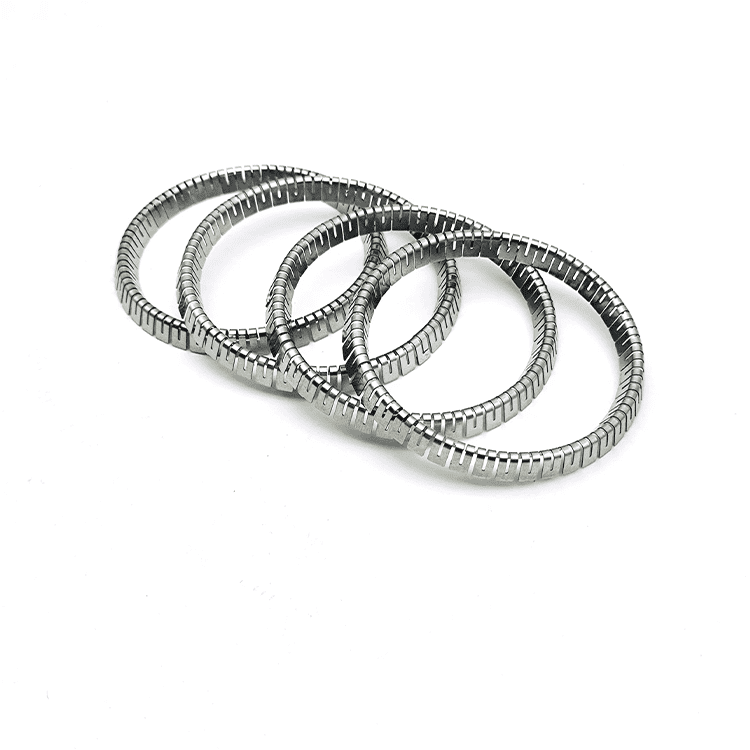
Unlike traditional compression springs, Cantilever V Springs are specifically designed to serve as energizing elements inside polymer seal jackets, ensuring consistent sealing performance across various operating conditions. Their unique geometry makes them suitable for both static and slow to moderate dynamic motion applications .
This comprehensive guide explores the engineering principles, advantages, material options, and selection criteria for Cantilever V Springs, helping you determine if they are the right choice for your application.
A Cantilever V Spring is manufactured from thin strips of sheet metal, most commonly stainless steel or other high-performance alloys, that are formed into a V shape . The key design feature is the series of relief cuts placed on alternating sides of the V, which allows the spring to be formed into a circular configuration for installation inside seal grooves.
The spring operates on a simple but effective principle: when installed within a seal jacket and compressed during assembly, the V-shaped legs deflect, storing mechanical energy. This stored energy creates a concentrated point-load at the leading edge of the seal, ensuring continuous contact between the sealing lip and the mating surface . The result is a reliable seal that compensates for wear, pressure fluctuations, and minor misalignments.
| Term | Description |
|---|---|
| Cantilever V Spring | Primary technical name describing the spring’s geometry and operating principle |
| V Spring | Common shortened name |
| Meander V Spring | Alternative name referencing the winding path of the spring strip |
| Punch Finger Spring | Industry term derived from the manufacturing process |
One of the most significant advantages of Cantilever V Springs is their exceptionally wide deflection range compared to other spring types . This characteristic makes them ideally suited for:
The increased deflection range ensures that the seal maintains contact with the mating surface even under fluctuating conditions, providing reliable performance where other spring types might lose effectiveness.
V Springs are among the most economical spring energizers to produce, especially in high volumes. They are manufactured by forming strips of sheet metal through progressive dies and punches, a process that offers excellent production efficiency . This manufacturing approach provides several benefits:
The V Spring’s design makes it particularly well-suited for high-temperature applications. At elevated temperatures (above 450°F/232°C), PTFE seal jackets can soften sufficiently that some spring types—particularly Canted Coil springs—may begin embedding into the seal lips .
The Cantilever V Spring’s comparatively large, flat footprint resists embedding much better, maintaining its energizing function even when the jacket material becomes more compliant. This makes V Springs the preferred choice for applications requiring operation at 500°F (260°C) and above .
When combined with highly wear-resistant seal materials like UHMW-PE, V Springs create extremely effective sealing solutions for thick and viscous media such as adhesives, epoxy resins, and similar substances . The focused point-load at the seal’s leading edge provides not only sealing but also effective scraping action to exclude media.
An additional advantage is the ability to stack or nest multiple V Springs within a single seal jacket. This configuration multiplies the spring load and allows for multiple, redundant sealing contact points, enhancing both sealing effectiveness and operational reliability .
V Springs can be manufactured with silicone filling that encapsulates the spring while still allowing it to provide energizing force to the seal jacket . This feature is particularly valuable in:
The performance and longevity of Cantilever V Springs depend significantly on proper material selection. Based on your application requirements—temperature, pressure, chemical exposure, and mechanical stress—different materials may be optimal .
| Material | Key Characteristics | Typical Applications |
|---|---|---|
| 301 Stainless Steel | High strength, good formability, excellent spring properties | General-purpose sealing, moderate temperatures |
| 302 Stainless Steel | Similar to 301 with slightly different composition | Standard industrial applications |
| 304 Stainless Steel | Excellent corrosion resistance, good formability | Food processing, pharmaceutical, general industry |
| 316 Stainless Steel | Superior corrosion resistance, especially against chlorides | Marine, chemical processing, medical devices |
| 17-7PH | Precipitation-hardening stainless steel, high strength | Aerospace, high-stress applications |
For extreme conditions involving high temperatures, aggressive chemicals, or critical reliability requirements, exotic alloys provide enhanced performance :
| Alloy | Key Characteristics | Typical Applications |
|---|---|---|
| Inconel® (600, 718, X-750) | Exceptional high-temperature strength, oxidation resistance | Aerospace engines, gas turbines, high-temperature processing |
| Hastelloy® (C22, C276, C2000) | Outstanding corrosion resistance in aggressive media | Chemical processing, pharmaceutical, offshore oil and gas |
| Elgiloy® / Phynox® | High strength, excellent fatigue life, non-magnetic | Medical devices, aerospace, instrumentation |
| Monel® 400 | Excellent corrosion resistance in marine environments | Marine applications, chemical processing |
V Springs can withstand temperatures ranging from -75°F to 500°F (-60°C to 260°C) and pressures exceeding 30,000 psi (2,068 bar) , making them suitable for a wide range of demanding applications .
Cantilever V Springs are available in multiple standard series, typically designated from -000 through -500, with each series offering specific dimensional characteristics .
| Series | A | B | C | D | E | F | J | K | L |
|---|---|---|---|---|---|---|---|---|---|
| -000 | 0.016″ | 0.067″ | 0.020″ | 0.080″ | 0.101″ | 0.010″ | 0.041″ | 0.003″ | 0.047″ |
| -100 | 0.010″ | 0.080″ | 0.030″ | 0.146″ | 0.176″ | 0.014″ | 0.080″ | 0.005″ | 0.071″ |
| -200 | 0.011″ | 0.100″ | 0.040″ | 0.202″ | 0.242″ | 0.029″ | 0.105″ | 0.006″ | 0.101″ |
| -300 | 0.020″ | 0.150″ | 0.055″ | 0.335″ | 0.390″ | 0.049″ | 0.160″ | 0.008″ | 0.173″ |
| -400 | 0.025″ | 0.200″ | 0.075″ | 0.477″ | 0.552″ | 0.065″ | 0.235″ | 0.010″ | 0.245″ |
| -500 | 0.035″ | 0.200″ | 0.150″ | 0.650″ | 0.800″ | 0.070″ | 0.360″ | 0.020″ | 0.318″ |
Source: MW Components dimensional data
| Series | A (mm) | B (mm) | C (mm) | D (mm) | E (mm) | F (mm) | J (mm) | K (mm) | L (mm) |
|---|---|---|---|---|---|---|---|---|---|
| -000 | 0.41 | 1.70 | 0.51 | 2.03 | 2.57 | 0.25 | 1.04 | 0.08 | 1.19 |
| -100 | 0.25 | 2.03 | 0.76 | 3.71 | 4.47 | 0.36 | 2.03 | 0.13 | 1.80 |
| -200 | 0.28 | 2.54 | 1.02 | 5.13 | 6.15 | 0.74 | 2.67 | 0.15 | 2.57 |
| -300 | 0.51 | 3.81 | 1.40 | 8.51 | 9.91 | 1.24 | 4.06 | 0.20 | 4.39 |
| -400 | 0.64 | 5.08 | 1.91 | 12.12 | 14.02 | 1.65 | 5.97 | 0.25 | 6.22 |
| -500 | 0.89 | 5.08 | 3.81 | 16.51 | 20.32 | 1.78 | 9.14 | 0.51 | 8.08 |
Source: MW Components dimensional data
If standard dimensions do not meet your requirements, minor variations to the “L” and “K” dimensions can often be accommodated with minor tooling adjustments. For more significant changes, hundreds of non-standard cross-sections may be available, or a completely custom toolset can be designed for your specific application .
Cantilever V Springs exhibit a linear load curve, meaning that the spring force increases proportionally with the amount of compression . This characteristic has important implications for seal design:
| Compression Level | Spring Force | Implication |
|---|---|---|
| Initial installation | Moderate | Seal properly energized |
| Mid-life operation | Optimal | Balanced performance |
| Near wear limit | Reduced | May require higher initial load |
Manufacturers provide load-deflection testing data for various material and series combinations:
This data enables engineers to predict spring performance accurately and select the optimal configuration for their specific application requirements.
Cantilever V Springs find widespread use across numerous industries due to their versatility, reliability, and cost-effectiveness.
V Spring-energized seals are commonly used in oil and gas applications involving extreme, dynamic environments. They provide leak-proof sealing in :
In semiconductor manufacturing equipment, V Spring seals provide reliable performance in :
The medical industry benefits from V Springs in applications requiring precision, cleanliness, and reliability :
V Springs are indispensable in modern aerospace systems, where extreme conditions demand exceptional performance :
The food industry relies on V Spring seals for :
V Springs are widely used in industrial fluid power applications :
Understanding how Cantilever V Springs compare to alternative spring energizers helps in selecting the optimal solution for your application .
| Characteristic | Cantilever V Spring | Canted Coil Spring | Helical Spring | Full Contact Spring |
|---|---|---|---|---|
| Load Curve | Linear | Flat (near-constant) | Linear | Progressive |
| Deflection Range | Widest | Wide | Moderate | Wide |
| Load Concentration | Point contact | Distributed multi-point | Distributed | Full contact |
| High-Temp Performance | Excellent | Good (embedding risk) | Good | Excellent |
| Rotary Suitability | Limited | Excellent | Good | Limited |
| Cost Efficiency | Excellent | Moderate | Good | Moderate |
| Small Diameter Capability | Limited | Excellent | Good | Limited |
| Yield Resistance | Moderate | Excellent | Good | Excellent |
V Springs are the optimal choice when:
Other spring types may be preferable when:
Cantilever V Springs are available in two primary forms :
Continuous Length Springs
Pre-Cut and Welded Springs
Eclipse fully welds every spring they produce to ensure consistent load around all points of the seal . Welding provides several advantages:
V Springs can be welded using simple resistance welding equipment, similar to most sheet metal fabrication processes .
While Cantilever V Springs offer numerous advantages, understanding their limitations ensures appropriate application selection.
The focused point-load that makes V Springs effective for scraping and sealing can be a drawback in some applications. This characteristic means V Springs are rarely used in rotary applications, where the relatively high point-loading would accelerate wear of both the seal and the mating hardware .
Because V Springs possess a linear load curve, the spring force gradually decreases as the seal wears . This means the seal may be overloaded initially and underloaded near the end of its wear life. For applications where constant force is critical throughout the seal’s life, Canted Coil springs with flat load curves may be preferable.
If a V Spring is over-compressed or distorted beyond its elastic limit, it will yield and no longer function properly . This can be a concern in systems with potential high back-pressure events. Canted Coil springs, by contrast, can be fully compressed without damage and are much more difficult to yield.
V Springs have lower diameter limitations compared to Canted Coil or Helical springs. At smaller diameters, the inner “tabs” of the V Spring can overlap and crowd around the inside diameter, limiting the small-diameter potential of some series .
For aerospace, defense, and other mission-critical applications, Cantilever V Springs can be engineered to perform in the most demanding environments .
The V-angle design converts vibrational energy into lateral displacement, reducing transmitted forces by up to 60% compared to helical springs . FEA-optimized geometries can shift natural frequencies away from system harmonics, protecting sensitive components.
Under system pressure, V Spring legs deflect outward, increasing radial contact force by up to 300% . This “live load” characteristic compensates for flange relaxation and thermal cycling, achieving zero leak rates (<1×10⁻⁹ cc/sec He) in critical applications.
Modern manufacturing capabilities enable extensive customization of Cantilever V Springs to meet specific application requirements .
With over 100 different cross-sections available, many custom requirements can be met without costly new tooling. When unique geometries are required, dedicated tool sets can be designed specifically for your application .
Having specialty materials stocked for production enables competitive pricing and shorter lead times compared to manufacturers who must order materials per project .
Follow these steps to select the optimal Cantilever V Spring for your application:
| Parameter | Considerations |
|---|---|
| Temperature | Minimum, maximum, and cycling requirements |
| Pressure | Operating pressure range and potential spikes |
| Media | Chemical compatibility with spring material |
| Motion | Static, reciprocating, or rotary (limited) |
| Diameter | Seal groove dimensions and tolerances |
| Deflection | Required compression range |
Based on environmental factors :
| Environment | Recommended Material |
|---|---|
| General industrial, moderate temperatures | 301/302/304 Stainless Steel |
| Corrosive environments, marine | 316 Stainless Steel |
| High temperature (>500°F/260°C) | Inconel® 718, X-750 |
| Highly corrosive chemicals | Hastelloy® C276 |
| Medical, high fatigue | Elgiloy® / Phynox® |
| High strength requirements | 17-7PH |
Using groove dimensions, select the appropriate series from standard tables. The key dimensions are :
Cantilever V Springs represent a time-tested, versatile solution for spring-energized sealing applications across virtually every industry. Their unique combination of wide deflection range, cost-effective manufacturing, excellent high-temperature performance, and material versatility makes them the preferred choice for countless applications .
While they have limitations—particularly in rotary applications and very small diameters—their advantages far outweigh drawbacks in suitable applications. When properly selected and installed, V Spring-energized seals provide reliable, long-lasting performance in some of the world’s most demanding environments, from deep-sea oil wells to outer space .
Whether you need standard sizes for immediate requirements or custom-engineered solutions for unique challenges, Cantilever V Springs offer the performance, reliability, and value that modern industry demands.