


Are your canted coil springs failing prematurely? Discover the critical differences between over-compression and under-compression, their impact on performance, and how to engineer the perfect working range for maximum reliability.
Canted coil springs are engineering marvels that deliver near-constant force across a wide deflection range, making them indispensable in aerospace connectors, medical devices, EMI shielding, and high-pressure sealing applications . Their unique tilted coil geometry allows them to maintain uniform contact pressure even under misalignment, with axial deflection capabilities up to 60% of free length .
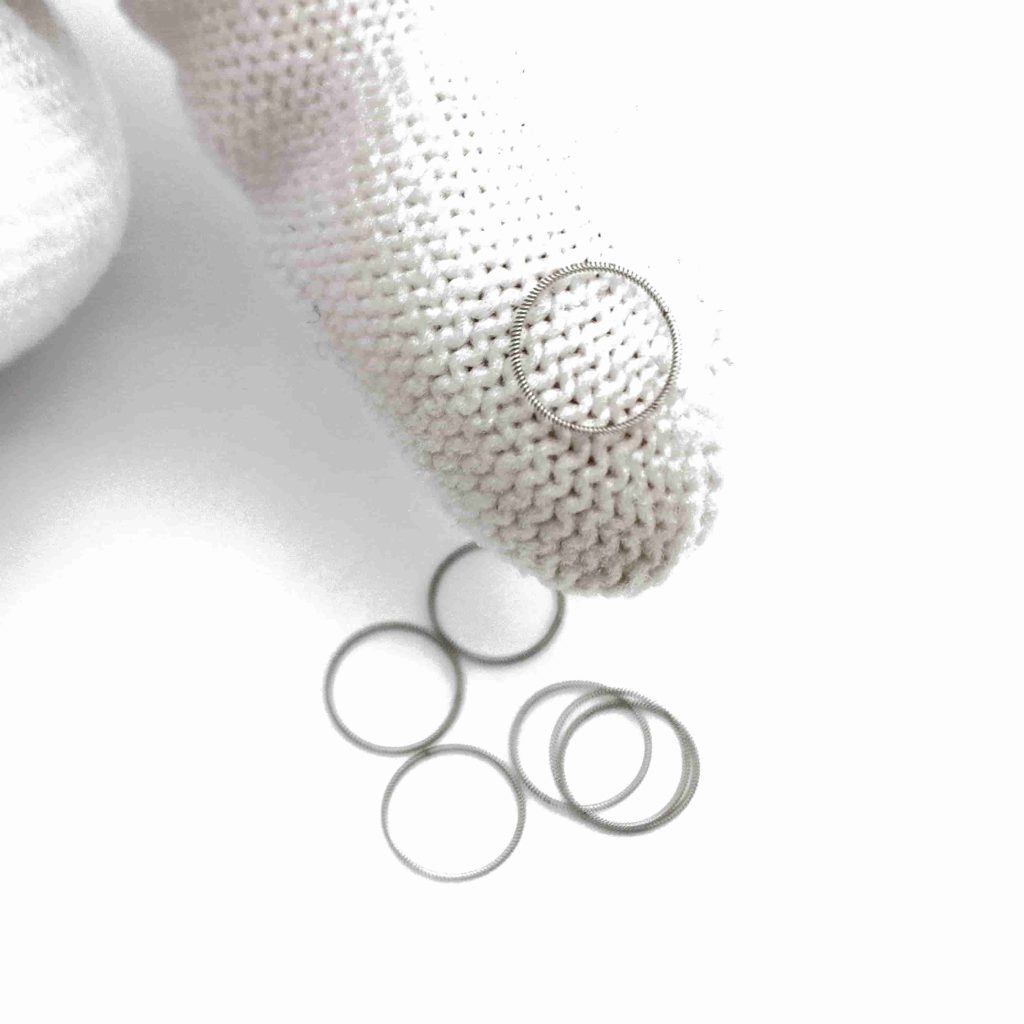
However, the very characteristic that makes these springs so versatile—their ability to function across a broad compression range—also creates a critical engineering challenge: operating outside the optimal working window leads to premature failure. Two failure modes dominate field returns and reliability issues: over-compression and under-compression.
This comprehensive guide explores the mechanical principles behind these opposing failure modes, their engineering consequences, and proven strategies to maintain your springs within the ideal performance envelope.
Before diving into failure modes, engineers must understand how canted coil springs behave under load. Unlike traditional compression springs, canted coil springs exhibit a unique force-deflection relationship characterized by three distinct regions .
Region 1: Initial Engagement (0–20% compression)
In this region, individual coils begin contacting mating surfaces. Force builds gradually as the spring establishes uniform contact. Operating here typically results in under-compression—insufficient force for reliable sealing or electrical conductivity .
Region 2: Linear Working Range (20–70% compression)
This is the sweet spot for canted coil spring performance. Force remains remarkably stable across this wide deflection range, providing consistent mechanical and electrical performance. The spring behaves elastically with minimal stress concentration .
Region 3: Over-Compression (>70% compression)
Beyond approximately 70–80% of free height, coils begin binding against each other and the groove walls. Stress rises exponentially, pushing the material toward its yield point. This is the domain of over-compression failure .
Figure 1: Typical Force-Deflection Curve for Canted Coil Springs
text
Force
  ↑
  |        Region 1    |    Region 2    |  Region 3
  |                    |                 |
  |                  ╱ |                 |
  |                ╱   |                 |
  |              ╱     |                 |    ╱
  |            ╱       |                 |  ╱
  |          ╱         |                 |╱
  |________╱___________|_________________|______→ Deflection
  0%       20%         70%              100%
  (Under)   (Optimal)   (Optimal)        (Over)
Over-compression occurs when a canted coil spring is compressed beyond its elastic limit—typically exceeding 70–80% of its free height . This pushes the spring material into plastic deformation territory, with irreversible consequences.
1. Permanent Set (Plastic Deformation)
When compression force exceeds the material’s yield strength, the spring undergoes plastic deformation. The coils take on a flattened, “set” shape that no longer returns to original dimensions . A spring that has experienced over-compression will show:
2. Force Relaxation and Preload Loss
Over-compression accelerates stress relaxation—the gradual loss of spring force under constant deflection. Research shows that over-compressed springs can lose 20–30% of their initial force within hours of installation, depending on material and temperature .
3. Extrusion Risk in High-Pressure Systems
In high-pressure valve applications, over-compression combined with differential pressure creates extrusion risk. When the spring is already fully compressed, fluid pressure can force coil material into clearance gaps, causing catastrophic failure .
4. Accelerated Fatigue Failure
Operating in the over-compression region subjects the spring to stress levels far beyond its fatigue endurance limit. Cycle life drops exponentially—springs rated for 10⁷–10⁹ cycles at moderate loads may fail in thousands of cycles when over-compressed .
| Cause | Description | Typical Industries |
|---|---|---|
| Incorrect groove depth | Groove too shallow, forcing spring into solid height | Aerospace, medical devices |
| Tolerance stack-up | Manufacturing tolerances combine to reduce available space | Automotive, industrial |
| Thermal expansion | Housing expands less than spring at high temperature | Oil & gas, downhole tools |
| Assembly misalignment | Angular insertion concentrates load on one side | Connectors, EMI shielding |
| Missing compression stops | No mechanical limit on travel | Latching mechanisms |
While over-compression causes dramatic, visible failures, under-compression is more insidious. Operating below 20% of free height may not damage the spring mechanically, but it compromises system function in equally serious ways .
1. Insufficient Contact Force
Canted coil springs rely on adequate compression to generate the force needed for sealing or electrical conductivity. Under-compressed springs deliver contact pressure below design specifications, leading to:
2. Electrical Contact Failure
For EMI and grounding applications, contact resistance is directly proportional to contact force. Under-compression can cause contact resistance to rise from the target 1–10 mΩ to unstable, high-resistance connections that generate heat and signal noise .
3. Seal Leakage in Pressure Applications
In spring-energized seals, the spring provides the initial sealing force before system pressure energizes the seal. Under-compression means inadequate initial force, allowing leakage at low pressures or during pressure transients .
4. Dynamic Instability
Springs operating at very low compression may shift within the groove during vibration or thermal cycling. This micro-movement causes wear, fretting corrosion, and inconsistent performance .
| Cause | Description | Typical Industries |
|---|---|---|
| Groove too deep | Spring cannot achieve sufficient compression | Medical, semiconductor |
| Incorrect spring selection | Light-load spring specified where medium-load needed | General engineering |
| Tolerance stack-up | Parts at maximum material condition reduce compression | Automotive, connectors |
| Thermal contraction | Housing shrinks away from spring at low temperature | Cryogenic, aerospace |
| Wear over time | Gradual material loss reduces spring height | High-cycle applications |
Material choice fundamentally determines how a canted coil spring responds to compression stress. Different alloys exhibit dramatically different resistance to over-compression damage and force relaxation .
| Material | Yield Strength | Max Temp | Force Loss (1000h @ 150°C) | Best Applications |
|---|---|---|---|---|
| 302 Stainless | ★★☆☆☆ | 250°C | 20–30% | General purpose, low stress |
| 316 Stainless | ★★☆☆☆ | 300°C | 15–25% | Corrosive environments |
| 17-7PH | ★★★★☆ | 350°C | 8–12% | Mechanical components |
| Beryllium Copper | ★★★☆☆ | 200°C | 8–15% | Electrical contacts, non-magnetic |
| Inconel X-750 | ★★★★★ | 650°C | <5% | High temperature, aerospace |
| Elgiloy® | ★★★★★ | 450°C | <5% | Medical, high-cycle, EMI |
| MP35N | ★★★★★ | 350°C | <5% | Implantable medical, corrosive |
Key Insight: Upgrading from standard stainless steel to a precipitation-hardened alloy can improve force retention by up to 50% and allow safe operation at higher compression percentages .
The groove that houses a canted coil spring is not merely a container—it is an integral part of the mechanical system that determines whether the spring operates in its optimal compression range .
Critical Groove Parameters:
Groove Depth
Groove Width
Corner Radius
Surface Finish
Table 3: Groove Design Impact on Compression Performance
| Groove Characteristic | Effect on Compression | Failure Risk |
|---|---|---|
| Depth: Too shallow | Forces over-compression | Plastic deformation |
| Depth: Optimal | Enables proper working range | Minimal |
| Depth: Too deep | Causes under-compression | Insufficient force |
| Width: Too narrow | Restricts coil movement | Binding, over-compression |
| Width: Optimal | Allows controlled deflection | Stable performance |
| Width: Too wide | Allows lateral migration | Extrusion, wear |
| Sharp corners | Stress concentration | Local over-compression |
| Smooth radius | Uniform load distribution | Extended life |
The consensus across engineering literature and manufacturer recommendations is clear: canted coil springs deliver optimal performance and maximum life when operated within 20–70% of their free height .
Lower Bound (20–30%)
Upper Bound (60–70%)
The 30% Safety Margin
Experienced designers target a working deflection of 20–50% of free height, leaving margin for:
Engineers need reliable methods to distinguish between over-compression and under-compression failures in the field.
Signs of Over-Compression:
Signs of Under-Compression:
Force-Deflection Measurement:
The most definitive diagnostic tool is comparing actual force-deflection curves to specification. Springs suffering over-compression show:
Contact Resistance Testing (Electrical):
For EMI and connector applications, rising contact resistance often indicates under-compression. A jump from <5 mΩ to >20 mΩ signals inadequate force .
Leak Rate Testing (Sealing):
In seal applications, increased leakage at low pressure points to under-compression, while leakage after thermal cycling may indicate over-compression damage .
Use the material selection guide above to match alloy to:
Collaborate with spring manufacturers during design, not after prototyping. Manufacturers can:
For critical applications, implement periodic inspection:
Aerospace applications demand operation within strict limits due to extreme temperature swings (−65°C to +150°C) and vibration. Design margins are typically more conservative, with working deflection limited to 20–40% of free height .
Implantable and surgical devices require absolute reliability over hundreds of millions of cycles. Materials like MP35N and Elgiloy® provide the fatigue resistance needed, with groove designs verified through extensive testing .
Downhole tools face extreme pressure (up to 20,000 psi) and temperature (175–250°C). Extrusion prevention requires careful groove design and Inconel® alloys. Over-compression here is catastrophic—springs must have mechanical stops .
For spiral spring EMI gaskets, under-compression is the primary concern. Inadequate force creates gaps that leak electromagnetic interference. Contact force must remain stable over temperature and time .
The Problem:
A medical device manufacturer experienced intermittent connector failures after 10,000 mating cycles. Field returns showed inconsistent contact resistance, with some connectors failing completely.
Diagnosis:
Force-deflection testing revealed two issues:
Solution:
Result:
Contact resistance stabilized below 5 mΩ through 100,000 cycles. Field failures eliminated .
Canted coil springs are remarkably forgiving components when operated within their intended range—and remarkably unforgiving when pushed to extremes. The difference between over-compression and under-compression is not merely academic; it determines whether your system delivers reliable performance for years or fails prematurely.
Key Takeaways:
🔹 Understand the force-deflection curve: Know where your spring operates relative to its 20–70% sweet spot
🔹 Design the groove, not just the spring: Groove geometry controls compression range
🔹 Choose materials wisely: Alloy selection determines how much compression the spring can tolerate
🔹 Account for real-world variation: Tolerances, temperature, and wear all affect compression
🔹 Validate through testing: Force-deflection curves reveal compression-related issues before field failures
By engineering for the optimal compression range, you unlock the full potential of canted coil spring technology: consistent force, reliable electrical contact, effective sealing, and exceptional service life—even in the most demanding applications.