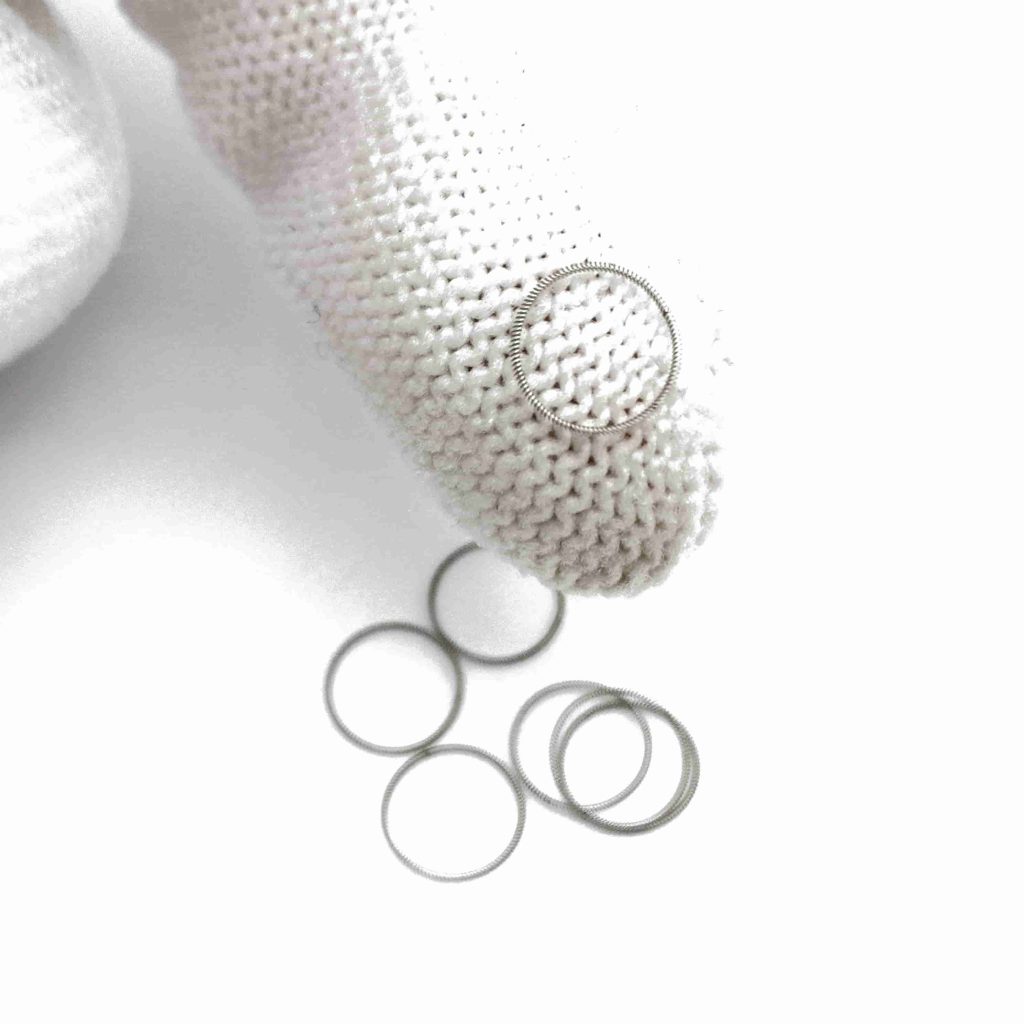
Canted coil springs—also known as slanted coil springs or oblique coil springs—are among the most versatile mechanical components in modern engineering. Their unique geometry provides near-constant force over a wide deflection range, making them ideal for sealing, EMI shielding, and electrical connection applications.
Yet despite their versatility, standard off-the-shelf canted coil springs often fail when applied to custom applications. Engineers who assume a standard spring will perform identically across different designs frequently encounter premature failure, inadequate contact force, or compromised performance.
This article explores the common reasons why standard コイルスプリング fail in custom applications and provides practical guidance for selecting or designing springs that will perform reliably in your specific use case.
A standard canted coil spring is manufactured to meet general-purpose specifications—typical force classes, standard materials, common platings, and conventional groove recommendations. While these springs perform well in the applications they were designed for, custom applications introduce variables that standard springs are not optimized to handle.
| Variable | Standard Spring Assumption | Custom Application Reality |
|---|---|---|
| Compression Range | 20–30% of free height | May require lower compression (10–15%) for dynamic applications or higher compression (30–40%) for extreme sealing |
| Force Requirement | Low, moderate, or standard force classes | May require intermediate force values not offered in standard classifications |
| 動作温度 | –40°C to 150°C (typical) | May require cryogenic (–200°C) or high-temperature (300°C+) capability |
| 環境 | Clean, dry, indoor | May involve salt fog, chemicals, vacuum, or outdoor exposure |
| Groove Design | Manufacturer-recommended dimensions | May be constrained by existing tooling, space limitations, or assembly requirements |

The most frequent cause of failure is incorrect compression. Standard springs are designed to operate within a specific compression range—typically 20–30% of free height. When installed in custom grooves that deviate from this range, performance suffers.
Under-compression (<20%):
Over-compression (>30%):
エンジニアリング・ソリューション: Calculate the installed compression precisely based on your groove dimensions. If the application requires compression outside the 20–30% range, consider a custom spring designed for that specific compression requirement.
Standard canted coil springs are categorized into force classes—typically Low Force (~1.5 lb/in), Moderate Force (~10 lb/in), and Standard Force (~30 lb/in) . These discrete classes may not align with the exact force requirements of custom applications.
Scenario: A custom sealing application requires 5 lb/in of contact force—too high for Low Force springs, but lower than the Moderate Force class. Using a Moderate Force spring may over-compress the seal lip, increasing friction and wear. Using a Low Force spring may not provide adequate sealing.
エンジニアリング・ソリューション: Request force-deflection curves from manufacturers. These curves allow you to select a spring based on actual force at your specific compression, rather than relying on broad classifications. For applications requiring force values between standard classes, custom springs can be manufactured with tailored wire diameters and coil geometries.
Standard springs are typically manufactured from common materials such as stainless steel 302/304 または beryllium copper. While these materials perform well in general environments, they may fail in custom applications with demanding conditions.
| 環境 | Standard Material Risk | 推奨素材 |
|---|---|---|
| High Temperature (>150°C) | Stainless steel relaxes; beryllium copper loses strength | Inconel, Hastelloy, or Elgiloy |
| Cryogenic (< –40°C) | Some materials become brittle | 316 stainless steel, beryllium copper |
| Salt Fog / Marine | 302 stainless steel corrodes | 316 stainless steel, Hastelloy |
| 化学物質への暴露 | Standard materials degrade | Hastelloy, Inconel, or PTFE-coated springs |
| High Vacuum | Organic residues outgas | Cleaned, low-outgassing materials (stainless steel, gold-plated) |
エンジニアリング・ソリューション: Define the full operating environment—temperature range, chemical exposure, humidity, vacuum requirements—before selecting material. Consult material compatibility charts and request material certifications from suppliers.
Plating is often an afterthought, yet it critically affects corrosion resistance, conductivity, and solderability. Standard springs may come with tin plating (good for general use) or no plating. Custom applications may require specific platings.
Common Plating Issues:
| Issue | Consequence |
|---|---|
| Tin plating in humid environments | Oxidation increases contact resistance; potential for intermittent connection |
| No plating in marine environment | Corrosion leads to spring failure |
| Incorrect plating thickness | Poor solderability or reduced corrosion protection |
| Gold plating on high-wear applications | Soft gold wears quickly; hard gold or nickel underplate required |
エンジニアリング・ソリューション: Specify plating based on environment and function:
Standard springs are designed to fit within manufacturer-recommended groove dimensions. Custom applications often have groove constraints—existing tooling, space limitations, or specific mating surface geometries—that deviate from these recommendations.
Groove Design Mistakes:
| Mistake | Consequence |
|---|---|
| 溝が深すぎる | Under-compression, insufficient force |
| Groove too shallow | Over-compression, accelerated relaxation |
| Groove too wide | Spring may roll or shift, uneven force distribution |
| Groove too narrow | Spring may bind, improper compression |
| Poor groove finish | Wear, inconsistent performance |
エンジニアリング・ソリューション: Treat groove design as a critical parameter. If the groove cannot match manufacturer recommendations, consider a custom spring designed specifically for your groove dimensions. Provide the manufacturer with:
コイルスプリング can be configured for radial または axial loading. Standard springs are typically optimized for one load type. Using a radial-optimized spring in an axial application (or vice versa) leads to improper compression and premature failure.
Visual Guide:
| Load Type | Compression Direction | Standard Spring Design | Custom Application Risk |
|---|---|---|---|
| Radial | Perpendicular to spring centerline | Coils oriented for radial deflection | Axial use causes uneven contact |
| Axial | Parallel to spring centerline | Coils oriented for axial deflection | Radial use may not compress properly |
エンジニアリング・ソリューション: Clearly specify load direction when selecting or ordering springs. If your application requires both radial and axial compliance, consult with the manufacturer about specialized designs.
Custom applications often involve multiple components with individual tolerances. The cumulative effect—tolerance stack-up—can result in actual compression significantly different from the design intent.
例
On a spring with 0.100-inch free height and 25% target compression (0.075-inch installed height), worst-case tolerance could result in compression ranging from 15% to 35%—outside the optimal range.
エンジニアリング・ソリューション:
| Failure Mode | Root Cause | Consequence | Prevention |
|---|---|---|---|
| Compression Mismatch | Groove dimensions deviate from recommended range | Insufficient or excessive force | Calculate actual compression; verify against specifications |
| Force Class Misalignment | Standard force classes don’t match requirement | Under-performance or over-stress | Use force-deflection curves; consider custom force |
| Material Incompatibility | Environment exceeds material limits | Corrosion, relaxation, or fracture | Define full environment; select appropriate alloy |
| Plating Errors | Wrong plating for environment | Oxidation, high resistance, corrosion | Specify plating based on environment and function |
| Groove Design Flaws | Non-standard groove geometry | Uneven force, improper compression | Design groove to recommendations or customize spring |
| Load Type Confusion | Radial spring used axially | Improper compression, failure | Specify load direction; use correct spring type |
| Tolerance Stack-Up | Cumulative tolerances exceed design range | Compression out of optimal range | Worst-case analysis; prototype validation |
| Scenario | 推薦 |
|---|---|
| Compression outside 20–30% range | Custom spring |
| Force required between standard classes | Custom spring |
| Non-standard groove dimensions | Custom spring |
| Extreme temperature or chemical exposure | Custom material selection |
| High-volume production with tight tolerances | Custom spring optimized for your application |
| Prototype or low-volume with standard groove | Standard spring may suffice |
Standard canted coil springs are excellent components for many applications, but they are not universal solutions. When applied to custom applications without careful consideration of compression, force requirements, materials, plating, groove design, load type, and tolerances, they frequently fail to meet performance expectations.
Successful implementation requires a shift from simply selecting a standard part number to engineering the spring for your specific application. By understanding the variables that affect spring performance and working with manufacturers who provide technical support and custom design capabilities, you can ensure reliable, long-term performance.
Need assistance selecting or customizing canted coil springs for your application? Contact our engineering team for groove design guidance, material recommendations, and custom spring solutions.