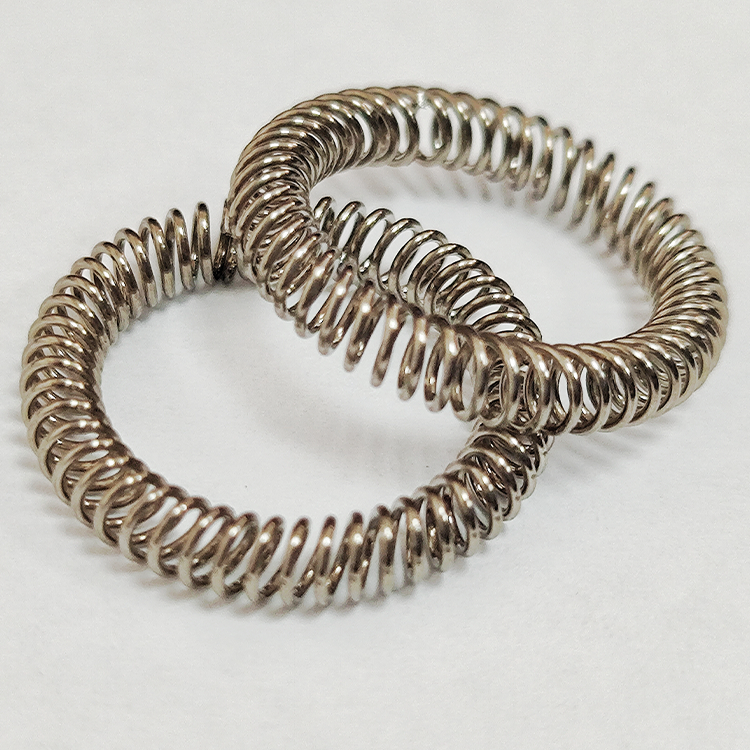
Selecting the right canted coil spring requires understanding load type, material, plating, and groove design. This comprehensive guide walks engineers through the key parameters to ensure optimal performance in sealing, EMI shielding, and conductive applications.
コイルスプリング—also known as slanted coil springs or oblique coil springs—are among the most versatile mechanical components used in modern engineering. Their unique geometry enables them to provide consistent force over a wide deflection range, making them ideal for applications ranging from high-performance sealing to critical EMI shielding and electrical connections.
However, selecting the right canted coil spring for a specific application requires more than matching a part number. Engineers must consider load type, force classification, material, plating, groove design, and environmental factors. This guide provides a systematic approach to making the right choice.

A canted coil spring is a precision-wound spring where individual coils are inclined (canted) at an angle relative to the spring’s centerline. This canting creates a unique mechanical behavior: when compressed, the coils roll rather than simply deflect, resulting in:
These properties make canted coil springs particularly valuable in three primary applications:
| 申し込み | Function |
|---|---|
| スプリング式シール | Maintains continuous sealing force against the seal lip |
| EMI/RFI Shielding Gaskets | Provides conductive contact between enclosure and door/frame |
| Electrical Connections | Ensures low-resistance contact in connectors and battery contacts |
The first decision in selecting a canted coil spring is identifying the direction of force application. Canted coil springs can be configured for two primary load types:
In radial loading, the spring is compressed perpendicular to its centerline. This configuration is used when the spring is installed in a groove on a piston or shaft, with the opposing surface (housing or bore) compressing the spring radially.
Typical applications:
In axial loading, the spring is compressed parallel to its centerline. The spring is typically installed in a face groove, with a mating flange or cover compressing it axially.
Typical applications:
Key point: Not all canted coil springs are suitable for both load types. Manufacturers typically offer specific spring designs optimized for either radial or axial loading. Specifying the correct load type is essential for achieving the intended performance.
Canted coil springs are available in multiple force classes, allowing designers to match the spring’s compressive force to the application’s requirements. The three standard force classifications are:
| Force Class | Approximate Force Range | 代表的なアプリケーション |
|---|---|---|
| Low Force | ~1.5 lb per linear inch | Plastic housings, low-friction seals, lightweight assemblies, sensitive electronics |
| Moderate Force | ~10 lb per linear inch | General industrial sealing, standard EMI shielding, medium-load connections |
| Standard Force | ~30 lb per linear inch | High-pressure seals, high-reliability EMI shielding, aerospace, military |
Selecting the appropriate force class involves balancing multiple factors:
Practical approach: When in doubt, start with the moderate force class—it provides a balanced starting point for most applications. Adjust up or down based on specific requirements.
Material selection affects the spring’s mechanical properties, corrosion resistance, temperature range, and conductivity. Common materials for canted coil springs include:
| 素材 | 主要物件 | Suitable Environments |
|---|---|---|
| ステンレス鋼 302/304 | Good corrosion resistance, moderate strength, cost-effective | General industrial, moderate temperatures, non-critical applications |
| ステンレススチール316 | 特に塩化物に対する優れた耐食性 | Marine environments, medical devices, chemical exposure |
| ベリリウム銅 (BeCu) | Excellent conductivity, good spring properties, non-magnetic | EMI shielding, electrical contacts, low-resistance connections |
| Hastelloy / Inconel | Outstanding corrosion resistance, high-temperature capability | Aerospace engines, downhole oil & gas, chemical processing |
| エルジロイ | High strength, excellent fatigue life, corrosion resistant | Medical implants, aerospace, high-cycle applications |
Plating options further enhance performance:
Proper groove design is essential for achieving the intended compression and force. The groove must be sized to accommodate the spring while ensuring correct compression.
| パラメータ | Definition | 重要性 |
|---|---|---|
| 溝の深さ | Distance from mounting surface to groove bottom | Determines compression percentage; too deep reduces force; too shallow over-compresses |
| 溝幅 | Lateral space for spring installation | Must allow spring to sit without binding; typically 10–20% wider than spring height |
| Groove Bottom Finish | Surface roughness of groove base | Smooth finish prevents wear; too smooth may reduce friction and cause spring movement |
Compression is expressed as a percentage of the spring’s free height:
Compression (%) = (Free Height – Installed Height) / Free Height × 100
Recommended compression ranges:
Critical note: Exceeding the recommended compression accelerates stress relaxation and reduces spring life. Insufficient compression leads to poor contact force and compromised performance.
The operating environment dictates material, plating, and potentially special coatings.
To ensure the selected spring meets application requirements, consider requesting or performing the following tests:
A force-deflection curve verifies that the spring’s force at the intended compression falls within specifications. This is the single most important test for confirming performance.
| Measurement | 目的 |
|---|---|
| Force at installed compression | Confirms sufficient contact force for sealing or conductivity |
| Force retention after aging | Validates long-term stability under temperature and environmental stress |
| 圧縮セット | Measures permanent deformation after prolonged compression |
The following flowchart summarizes the key decision points in selecting a canted coil spring:
テキスト
Start: Identify Application Type
│
▼
Is the spring used for sealing, EMI shielding, or electrical connection?
│
▼
Determine Load Type: Radial or Axial?
│
▼
Select Force Class: Low, Moderate, or Standard?
│
▼
Choose Material & Plating based on environment, temperature, and conductivity requirements
│
▼
Define Groove Dimensions to achieve 20–30% compression
│
▼
Verify with force-deflection testing
│
▼
Finalize Selection
Excessive compression—whether from overly shallow grooves or incorrect spring selection—leads to accelerated force relaxation. Over time, the spring loses contact force, compromising sealing or shielding performance.
Not all canted coil springs provide the same force. Using a low-force spring where a moderate-force spring is required results in insufficient contact. Conversely, a standard-force spring in a plastic housing may cause deformation.
Standard tin plating performs well in clean, dry environments but oxidizes in humid conditions. For applications exposed to moisture or salt fog, specify nickel, gold, or appropriately plated beryllium copper.
Canted coil spring designs vary significantly between manufacturers. Always refer to the manufacturer’s specifications for force-deflection data, groove recommendations, and environmental limits.
Stack-up tolerances can result in actual compression being different from the design intent. Consider worst-case tolerance analysis to ensure the spring remains within its recommended compression range under all conditions.
Selecting the right コイルスプリング requires a methodical approach that considers load type, force classification, material, plating, groove design, and environmental conditions. Each parameter interacts with the others—a high-force spring in a plastic housing may cause damage, while a low-force spring in a corrosive environment may lose conductivity prematurely.
By following the selection framework outlined in this guide, engineers can confidently choose canted coil springs that deliver reliable, long-term performance in sealing, EMI shielding, and electrical connection applications.
When in doubt, consult manufacturer specifications, request force-deflection data, and validate with testing under real-world conditions. The extra effort in selection ensures that the final product performs as intended—consistently and reliably.