


Discover the most common testing mistakes in canted coil spring qualification and learn how to avoid failures in electrical contact, EMI shielding, sealing, and mechanical performance testing.
Canted Coil Spring systems are widely used in aerospace, medical devices, connectors, semiconductor equipment, oil & gas, and high-performance industrial applications. Their unique angled-coil structure provides reliable force, low insertion force, excellent conductivity, and long cycle life.
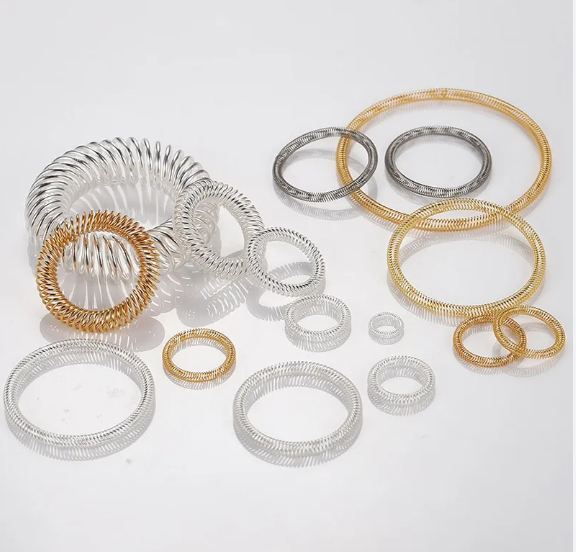
However, many engineering teams encounter unexpected failures during product qualification because the testing process itself is incomplete or inaccurate. A canted coil spring that performs perfectly in laboratory conditions may fail prematurely in real-world applications if the qualification method does not reflect actual operating environments.
In many cases, the problem is not the spring design — it is the testing strategy.
This article explains the most common testing mistakes in canted coil spring qualification, why they happen, and how engineers can improve validation accuracy before mass production.
Qualification testing verifies whether a canted coil spring can consistently meet mechanical, electrical, environmental, and sealing requirements throughout its service life.
Improper testing may lead to:
A failed qualification process can result in expensive redesigns, warranty claims, and delayed product launches.
Before discussing testing mistakes, engineers must understand the key performance parameters.
| Parameter | Purpose |
|---|---|
| Load vs Deflection | Measures spring force characteristics |
| Contact Resistance | Evaluates electrical conductivity |
| Compression Set | Measures permanent deformation |
| Cycle Life | Determines fatigue durability |
| EMI Shielding Effectiveness | Validates electromagnetic sealing |
| Temperature Stability | Ensures performance in extreme environments |
| Corrosion Resistance | Confirms material durability |
| Wear Resistance | Evaluates friction and abrasion behavior |
One of the biggest qualification mistakes is testing the spring under unrealistic laboratory conditions.
Engineers may test:
But actual applications may involve:
A spring may pass initial testing but fail in actual service because material properties change dramatically under real operating conditions.
For example:
Always simulate:
Many qualification programs focus only on static compression testing.
Static testing only measures force at fixed compression points.
However, many canted coil springs operate in:
Without dynamic testing, engineers may miss:
| Test Type | Purpose |
|---|---|
| Cycle Testing | Evaluates fatigue life |
| Vibration Testing | Simulates operational movement |
| Sliding Wear Test | Measures friction damage |
| Shock Testing | Verifies impact resistance |
Canted coil springs are highly sensitive to compression levels.
Testing springs outside their recommended working deflection range.
This includes:
Over-compression may cause:
Under-compression may cause:
Use accurate groove and housing tolerances to maintain optimal working deflection.
Typical working deflection ranges vary by design and application.
Improper fixtures are a hidden source of inaccurate qualification data.
Bad fixtures can create false test results such as:
Fixtures should replicate:
Some engineers only measure initial contact resistance.
This is a major mistake.
Electrical performance can degrade over time due to:
Measure resistance:
| Stage | Required Evaluation |
|---|---|
| Initial | Baseline conductivity |
| Mid-Life | Resistance stability |
| End-of-Life | Long-term reliability |
Material selection greatly influences qualification success.
| Material Issue | Possible Failure |
|---|---|
| Galvanic corrosion | Increased resistance |
| Incorrect plating | Rapid wear |
| Low-temperature brittleness | Cracking |
| High-temperature softening | Force loss |
Using standard stainless steel in high-temperature aerospace applications may cause force relaxation over time.
In corrosive environments, materials like:
may provide better long-term performance.
Many qualification programs stop testing too early.
Testing only hundreds or thousands of cycles when actual applications may require:
Short-duration tests may fail to reveal:
Establish qualification cycles based on:
For EMI applications, many engineers only verify physical fit instead of true shielding effectiveness.
Common mistakes include:
A spring may appear mechanically acceptable but fail EMI performance at high frequencies.
Test across:
Measure:
Prototype performance does not always represent production performance.
Testing only hand-made samples can hide:
Qualification should include:
Spring qualification is often isolated within one department.
Mechanical engineers may focus on force.
Electrical engineers may focus on conductivity.
Manufacturing teams may focus on assembly.
Without collaboration, important risks are missed.
| Department | Focus |
|---|---|
| Mechanical Engineering | Load and fatigue |
| Electrical Engineering | Resistance and EMI |
| Manufacturing | Process capability |
| Quality Assurance | Reliability validation |
| Procurement | Material consistency |
Depending on the application, engineers may reference standards from organizations such as:
Specific standards vary by industry and product type.
Successful canted coil spring qualification requires more than simple compression testing. Many failures originate from unrealistic test environments, poor fixture design, incomplete cycle testing, or inadequate electrical validation.
By understanding the most common testing mistakes, engineers can improve qualification accuracy, reduce field failures, and ensure long-term product reliability.
A properly qualified Canted Coil Spring can provide exceptional performance in demanding applications — but only when the testing process truly reflects real operating conditions.
You have not enough Humanizer words left. Upgrade your Surfer plan.
