


In high-reliability applications such as packings, precision machinery, and aerospace, a stable preload directly affects sealing performance and service life.With traditional springs, the load increases rapidly as compression deepens, which can easily lead to increased friction, accelerated wear, and higher drive force requirements. In contrast, canted coil springs are capable of maintaining a near-constant load over a wide deflection range, making them the preferred energy-storage component for many high-end packings.
So, why are canted coil springs able to achieve a near-constant load? This article will analyze this phenomenon from four perspectives: structural principles, load variation, engineering applications, and selection recommendations.
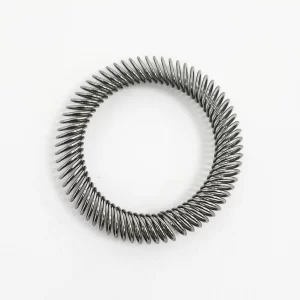
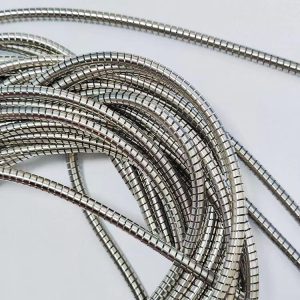
To learn more about our products, please visit:Explore Our Canted Coil Spring Product Range
Most engineers are familiar with the basic behavior of a conventional compression spring.Within its elastic range, the spring load generally increases as compression increases.This means:
While this behavior is acceptable for many applications, it can become a disadvantage in dynamic sealing systems.A rapidly increasing spring force may result in:
In many sealing applications, the goal is not to maximize spring force, but to maintain a stable and predictable preload throughout the working stroke.
The answer lies in its unique geometry.Unlike a conventional compression spring, a Canted Coil Spring consists of a series of coils that are intentionally wound at an angle.When compressed, the spring does not transfer the load equally to every coil at the same time.Instead, the angled coils gradually engage during compression, allowing the load to be distributed progressively throughout the spring.As a result:
This is why a canted coil spring can maintain a relatively stable load over a much larger deflection range than a conventional compression spring.
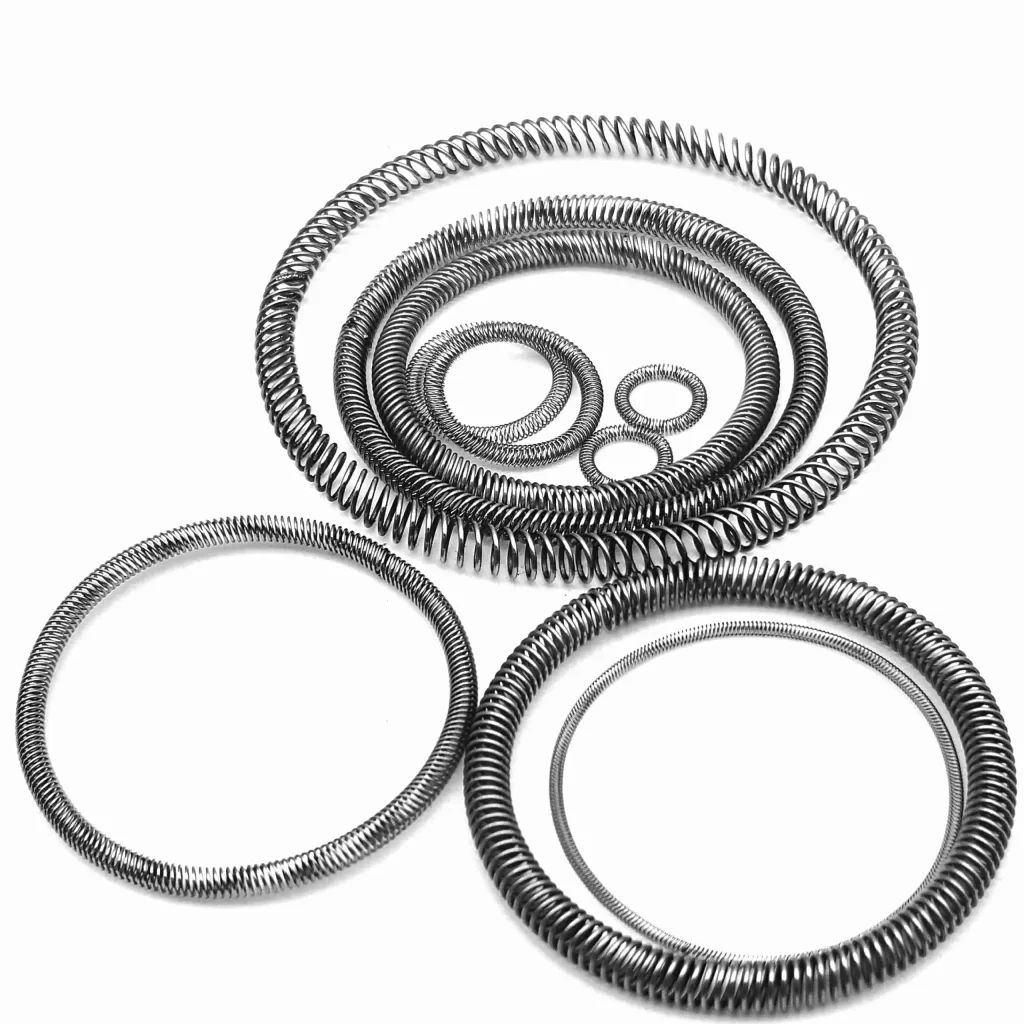
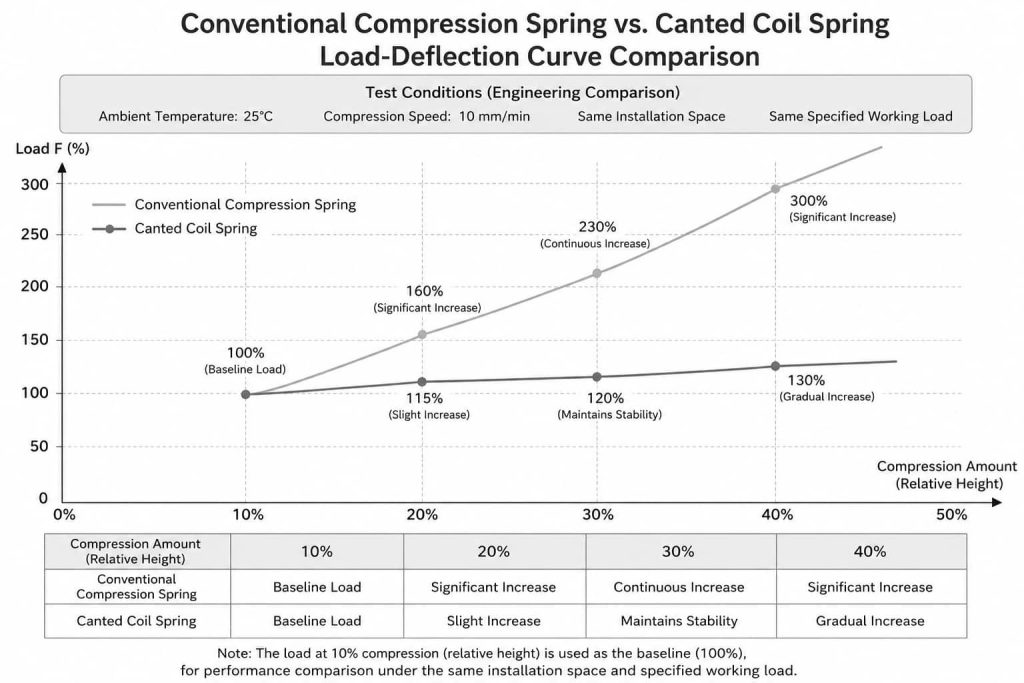
The following example illustrates the typical difference between a conventional compression spring and a canted coil spring.Illustrative Engineering Comparison Test Conditions:
| Relative Compression | Conventional Compression Spring | Canted Coil Spring |
| 10% | Baseline load | Baseline load |
| 20% | Noticeable increase | Slight increase |
| 30% | Continues to rise | Nearly stable |
| 40% | Significant increase | Gradual increase |
Note: Actual load values vary depending on spring geometry, material, and operating conditions. The table above illustrates the typical load trend rather than universal test data.From an engineering perspective, the flatter load curve of a canted coil spring helps reduce variations in operating force throughout the working stroke.👉 Not sure which canted coil spring is suitable for your application?Contact Our Engineering Team
For spring-energized seals, maintaining a stable preload is often more important than achieving the highest possible spring force.A more stable load can provide several practical benefits.
| Performance Factor | Rapidly Increasing Load | Stable Load |
| Breakout Force | Higher | Lower |
| Friction Variation | Larger | Smaller |
| Seal Lip Wear | Faster | Slower |
| Long-Term Stability | Moderate | Better |
In applications involving continuous reciprocating motion, a stable spring load helps minimize friction fluctuations, contributing to longer seal life and more consistent equipment performance.
Dynamic sealing systems require the spring to compress and recover repeatedly throughout the life of the equipment.If the spring force changes significantly during operation, the sealing pressure also fluctuates, which may lead to increased wear and inconsistent sealing performance.Because a canted coil spring provides a flatter load-deflection curve, it is commonly used in applications such as:
For these reasons, many engineers choose canted coil springs over conventional spring designs.Learn more about our engineering solutions:Visit Handa Spring
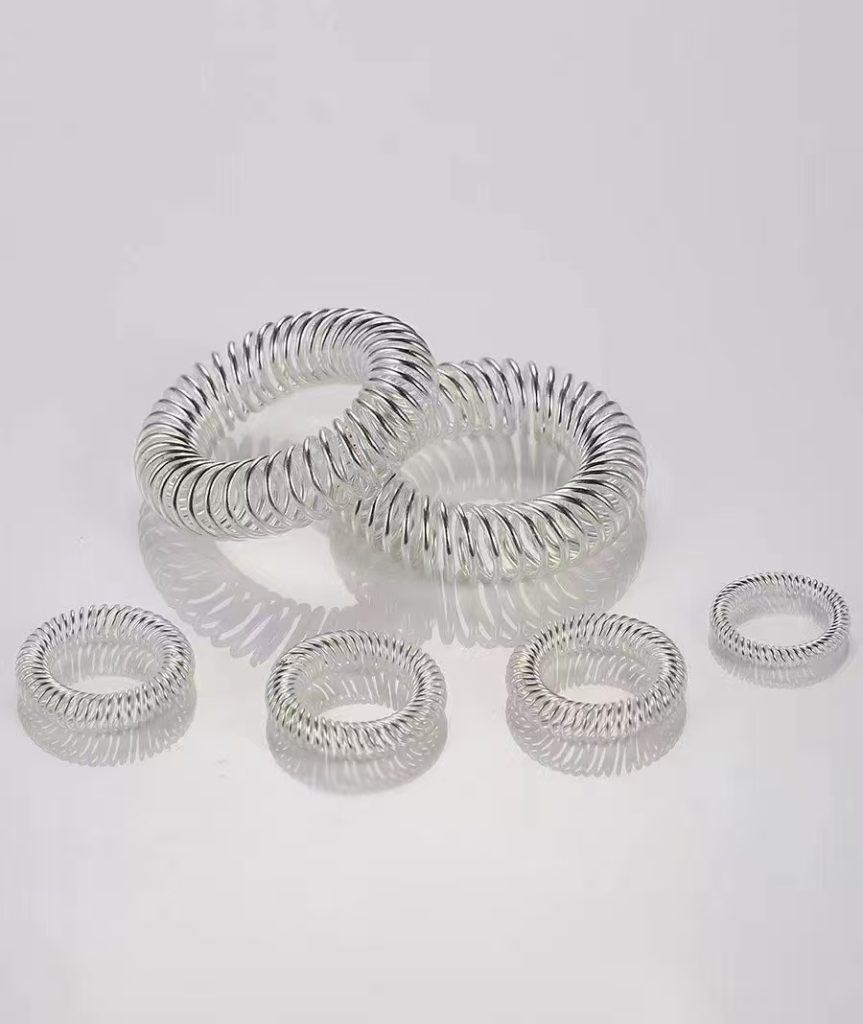
Selecting the correct spring is only part of the design process.To fully utilize the performance advantages of a canted coil spring, engineers should also optimize the groove design and operating conditions.The following factors deserve particular attention.
| Design Parameter | Engineering Recommendation |
|---|---|
| Compression Ratio | Stay within the recommended range and avoid over- or under-compression. |
| Groove Depth | Avoid under-preloading or over-compressing the spring to ensure proper operation. |
| Groove Width | Provide sufficient space to allow the spring to move and deform normally |
| Material Selection | Select the appropriate material based on the operating temperature and the medium environment. |
| Operating Conditions | Taking into account pressure, medium, cycle life, and operating environment |
Optimizing these parameters early in the design stage helps maximize the near-constant load performance of the canted coil spring.👉 Need assistance selecting the right spring or optimizing your groove design?Talk to Our Engineers
A Canted Coil Spring maintains a stable load over a wide deflection range not because its force remains perfectly constant, but because its unique angled-coil geometry allows the load to increase much more gradually than that of a conventional compression spring.For engineers designing spring-energized seals and other high-reliability mechanical systems, this near-constant load characteristic offers important advantages, including reduced friction, improved sealing consistency, longer service life, and enhanced system reliability.If you are looking for a canted coil spring solution tailored to your application, visit:https:www.handaspring.com.Our engineering team can provide:
