


Why are more and more engineers opting for helical springs with an angled profile?
In pan-seal assemblies, conductive connectors and high-reliability sealing systems, spring contacts play a crucial role in providing preload, compensating for wear and maintaining stable contact. In the past, traditional solutions such as compression springs and wave springs were the mainstream choices. However, as equipment has evolved towards miniaturisation, extended service life and high reliability, traditional springs have gradually revealed issues such as uneven contact pressure, significant load decay, poor space utilisation and dynamic off-centre loading.Consequently, an increasing number of engineers are turning to helical springs with an angled coil as an alternative solution.
So, compared to traditional spring contacts, what exactly are the advantages of helical springs? How should one select the appropriate type for different operating conditions?This article will provide a detailed comparison from an engineering application perspective.
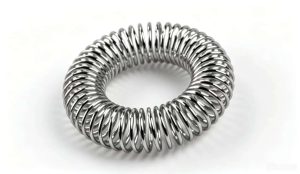
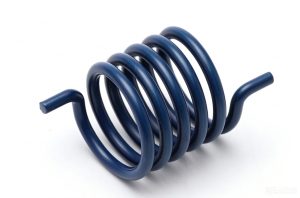
Unlike traditional compression springs, a canted coil spring features a continuous angled-coil structure, with each coil positioned at a specific angle.When compressed, the load is not concentrated at a single point. Instead, it is distributed across multiple coils, allowing the spring to share the load more evenly.This unique design gives canted coil springs several important advantages:
To learn more about product designs and specifications, please visit:Handa Spring Official Website
For sealing systems, stable preload is often more important than higher load.Especially in spring-energized seals, excessive fluctuations in spring force may lead to:
Load Stability Test, Test Conditions:
| Spring Type | Initial Load (N/mm) | Load Retention After 500,000 Cycles |
|---|---|---|
| Canted Coil Spring | 0.42 | 95% |
| Wave Spring | 0.48 | 84% |
| Compression Spring | 0.55 | 79% |
The test results show that canted coil springs maintain a significantly higher level of load stability during long-term cycling.This is one of the reasons why many premium spring-energized seals incorporate canted coil springs as their energizing elements.
👉 Not sure whether your sealing system is suitable for a canted coil spring? Feel free to contact our engineering team.
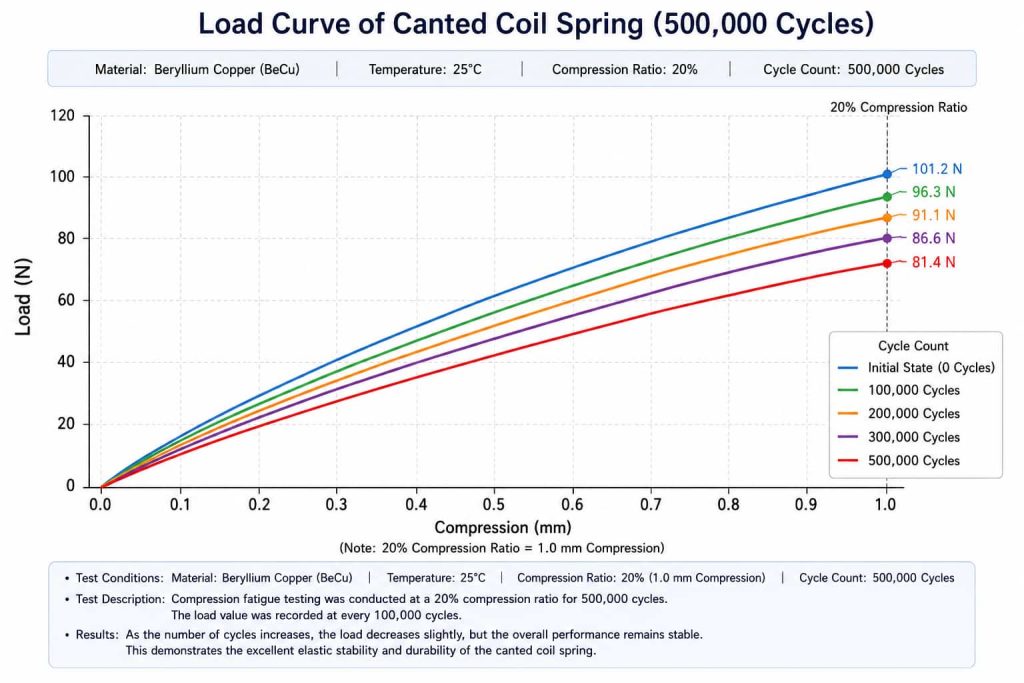
In applications involving frequent start-stop operations or reciprocating motion, spring life directly affects maintenance intervals and equipment reliability.
Traditional springs tend to experience plastic deformation after prolonged compression, whereas canted coil springs generally offer longer cycle life because stresses are distributed more evenly throughout the spring structure.
Service Life Comparison,Test Conditions:
| Spring Type | Permanent Set Begins | Load Retention After 1 Million Cycles |
| Canted Coil Spring | >1,000,000 cycles | 93% |
| Wave Spring | 400,000 cycles | 78% |
| Compression Spring | 350,000 cycles | 71% |
For long-cycle equipment such as that used in the semiconductor, medical and aerospace hydraulics industries, Canted Coil Spring are the more reliable choice..Learn more about our products:🔗 Explore Our Canted Coil Spring Product Range.
One of the major trends in modern equipment design is miniaturization.However, limited installation space often restricts the use of traditional spring designs.
Space Utilization Test, Test Conditions:
| Spring Type | Minimum Installation Height | Maximum Compression Capability | Space Utilization |
| Canted Coil Spring | 2.1 mm | 30% | High |
| Wave Spring | 3.0 mm | 20% | Medium |
| Compression Spring | 4.0 mm | 25% | Low |
Because canted coil springs can deliver stable loads within a compact envelope, they are particularly suitable for:
👉 Developing a space-constrained product? Contact us for structural optimization recommendations
In real-world manufacturing, machining tolerances and assembly deviations are unavoidable.Traditional springs are often sensitive to dimensional changes.In contrast, canted coil springs offer a certain degree of self-adjustment capability.
Misalignment Test,Test Conditions:
| Spring Type | Misalignment Behavior | Contact Stability |
| Canted Coil Spring | No significant misalignment | Stable |
| Wave Spring | Slight misalignment | Moderate |
| Compression Spring | Significant misalignment | Poor |
Helical springs perform more consistently within wider manufacturing tolerances. For further guidance on selecting the right type:🔗Learn More Technical Information
| Application | Recommended Solution | Reason |
| Spring-Energized Seals | Canted Coil Spring | Stable load and low friction |
| High-Cycle Mechanisms | Canted Coil Spring | Long service life |
| General Mechanical Cushioning | Compression Spring | Lower cost |
| Compact Mechanisms | Canted Coil Spring | Space-saving design |
| Static Support Applications | Wave Washer Spring | Simple structure |
When selecting a canted coil spring, engineers should carefully evaluate the following parameters:
Identifying these parameters early in the design phase can significantly reduce later redesign costs.👉 Unsure how to select the right canted coil spring? Consult our engineers today
Traditional spring contacts continue to play a vital role in many applications, but for engineers seeking high reliability, long service life and compact designs, angled coil springs are becoming an increasingly important solution.Particularly in the fields of hermetic seals, precision machinery, semiconductor equipment and aerospace, angled coil springs have become standard features in many high-end products.
If you are looking for a spring solution that combines load stability, long service life, and efficient space utilization, please visit:🔗 www.handaspring.com.Our engineering team can provide:
✓ Free application support
✓ Groove design recommendations
✓ Sample testing services
✓ Customized development solutions
