


Discover the complete engineering guide to detached leg springs—their unique independent-leg design, material options, critical applications, and selection criteria. Learn how to choose the right spring for electrical contacts, EMI shielding, and high-reliability systems.
In precision engineering, achieving consistent contact force across misaligned surfaces while maintaining a compact footprint is a persistent challenge. Traditional spring designs—where both ends are fixed or the coil is continuous—often fall short when faced with uneven mating surfaces, tight space constraints, or demanding reliability requirements.
Enter the detached leg spring, also known as a fishback spring or independent leg spring. This specialized mechanical component has become indispensable in electrical connectors, EMI shielding systems, and precision electronic assemblies, where reliable contact force and space efficiency are non-negotiable.
This comprehensive guide explores the engineering principles behind detached leg springs, their unique design features, available materials, critical applications, and step-by-step selection criteria.
A detached leg spring is a mechanical spring designed with separate leg structures that provide controlled contact force and flexibility. Unlike traditional springs where the legs are integrated into a continuous coil structure, detached leg springs feature independent legs that can flex individually, allowing improved mechanical compliance and consistent electrical contact.
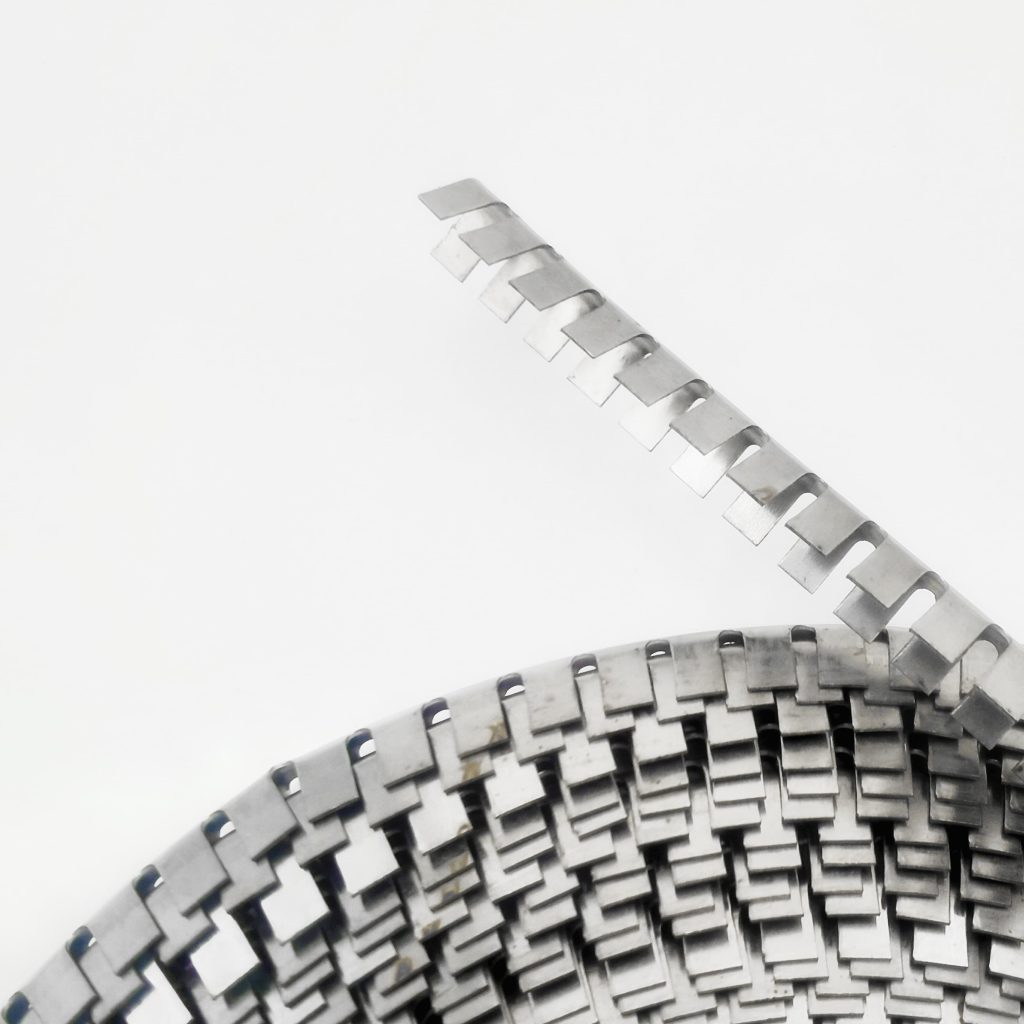
The spring typically consists of three main components:
These springs are also sometimes called fishback springs due to their characteristic geometry, which allows for a greater heavy load over a wide deflection range. They can be used in both static and dynamic applications and are produced in continuous lengths.
When installed in a device, the detached legs compress independently when contact pressure is applied. The spring body stores elastic energy during compression, while the legs maintain stable contact force against the mating surface. Because each leg can flex independently, the spring can adapt to slight misalignment or vibration, ensuring reliable contact over long operating cycles.
This independent leg movement is the defining characteristic of detached leg springs. The legs are capable of flexing, bending, and absorbing forces without being fixed to an anchor at both ends, which allows for precise force modulation and flexible load distribution.
Detached leg springs are widely used because of their unique mechanical characteristics:
Each leg moves independently, which allows the spring to maintain stable contact even when the mating surfaces are uneven or misaligned. This feature is particularly valuable in applications where component tolerances stack up or thermal expansion causes relative movement between parts.
A properly designed detached leg spring provides uniform force distribution, which improves electrical reliability and reduces contact resistance. The separation of legs allows for better distribution of forces and offers enhanced resilience under high loads.
Detached leg springs can be designed in small and precise geometries, making them ideal for compact electronic assemblies where real estate is at a premium.
High-quality materials such as stainless steel, beryllium copper, MP35N, and Elgiloy® allow the springs to withstand thousands of compression cycles without losing performance. Many detached leg springs are made from corrosion-resistant materials, making them suitable for use in harsh environments, including exposure to chemicals, moisture, and extreme temperatures.
Another significant feature is their heavy load geometry, which enables them to handle large forces over a wider deflection range. The geometry is optimized to ensure forces are evenly distributed across the spring‘s structure, making them highly suitable for industrial machinery, automotive suspensions, or high-load sealing applications.
Detached leg springs excel at absorbing and dissipating energy. In mechanical systems subjected to repetitive or sudden forces, such as vibrations or shocks, these springs act as dampening devices, ensuring smooth operation and reducing stress on surrounding components.
The following table compares detached leg springs with traditional spring designs:
| Feature | Detached Leg Spring | Traditional Spring |
|---|---|---|
| Contact stability | Very high | Moderate |
| Alignment tolerance | High | Low |
| Electrical reliability | Excellent | Good |
| Compact design | Excellent | Moderate |
| Fatigue resistance | High | Medium |
Because of these advantages, detached leg springs are widely used in high-reliability electronic systems where failure is not an option.
Material selection plays a critical role in spring performance. The choice of material directly affects the spring‘s load capacity, fatigue life, corrosion resistance, and environmental compatibility.
The Detached Leg Spring is available in five standard sizes in 301 stainless steel and four standard sizes in Elgiloy material.
When designing or selecting a detached leg spring, engineers must specify the following parameters:
Standard manufacturing tolerances apply to all dimensions and can be requested from the manufacturer.
| Parameter | Description |
|---|---|
| Contact force | Force exerted by each independent leg against mating surface |
| Load deflection curve | Relationship between compression distance and spring force |
| Maximum compression | Maximum allowable compression before permanent deformation |
The number of legs, their thickness, and the material type all influence the load-bearing capacity of these springs.
Detached leg springs are typically manufactured using standard tooling for their base geometries. Minor variations to dimensions can be made with minor adjustments to tooling. The springs are produced in continuous lengths, allowing for efficient manufacturing and customization.
More significant changes—such as non-standard cross-sections or custom geometries—may require non-standard tooling. Engineers should contact manufacturers early in the design process to understand feasibility and lead times for custom configurations.
Due to their distinctive design, detached leg springs are employed across multiple industries. The following sections detail the key sectors where detached leg springs serve as critical components.
Detached leg springs are commonly used in electrical connectors, EMI shielding systems, and precision electronic assemblies. Their ability to maintain consistent contact force across misaligned surfaces makes them ideal for:
The uniform force distribution improves electrical reliability and reduces contact resistance.
Detached leg springs play a crucial role in electromagnetic interference (EMI) shielding applications. Their multiple independent contact points create continuous conductive paths between enclosure surfaces, preventing electromagnetic leakage.
Key features for EMI shielding include:
In the automotive industry, detached leg springs play an essential role in vehicle suspension systems, brakes, and other mechanical components:
Aerospace applications demand the highest levels of reliability and performance. Detached leg springs are used in:
Materials like MP35N and Inconel are often specified for aerospace applications due to their high strength and corrosion resistance.
The medical industry requires springs that are reliable, biocompatible, and capable of withstanding sterilization processes. Elgiloy® offers superior fatigue resistance and is widely used in medical and precision devices. Applications include:
Detached leg springs are employed in industrial machinery where high load tolerance and durability are critical:
Detached leg springs are highly versatile and can function in both static and dynamic environments. In static applications, they support stationary loads, maintaining force equilibrium and ensuring stable operation. In dynamic applications, they perform exceptionally well due to their high deflection range and flexibility.
Follow these steps to select the optimal detached leg spring for your application:
| Requirement | Questions to Answer |
|---|---|
| Function | Is this for electrical contact, EMI shielding, mechanical force, or sealing? |
| Load direction | Is the force compressive, tensile, or dynamic? |
| Force requirement | What is the target contact force at installed compression? |
| Cycle life | How many compression cycles must the spring withstand? |
| Space constraints | What are the available dimensions for installation? |
| Environment | Material Consideration |
|---|---|
| Temperature extremes | Inconel for high temperature; stainless steel for wide range |
| Corrosion exposure | Stainless steel 316, Hastelloy, or Elgiloy |
| Moisture/humidity | Corrosion-resistant alloys with appropriate plating |
| Vacuum | Low-outgassing materials (stainless steel, gold-plated) |
| Chemical exposure | Hastelloy, Monel, or PEEK for chemical resistance |
| Priority | Recommended Material |
|---|---|
| Highest conductivity | Beryllium copper |
| Highest fatigue resistance | Elgiloy® |
| Best corrosion resistance | Hastelloy C276, 316 stainless steel |
| Highest strength | MP35N, 17-7PH stainless steel |
| Cost-effectiveness | 301 stainless steel |
| High-temperature capability | Inconel |
Detached leg springs can be customized to meet specific mechanical or environmental requirements. Engineers can adjust the spring‘s leg length, diameter, material composition, and other features to optimize performance for different applications.
If standard sizes (five in 301 stainless steel, four in Elgiloy) do not meet your requirements, manufacturers offer custom sizes produced from specialty materials. Customization options include:
The following dimensional data represents standard detached leg spring sizes available from manufacturers. All dimensions are subject to standard manufacturing tolerances.
| Part Number | Dimension A | Dimension B | Dimension C |
|---|---|---|---|
| CS-138 | 0.098″ | 0.355″ | 0.016″ |
| CS-141 | 0.039″ | 0.221″ | 0.256″ |
| CS-140 | 0.157″ | 0.358″ | 0.020″ |
| CS-139 | 0.125″ | 0.410″ | 0.020″ |
| CS-137 | 0.079″ | 1.049″ | 0.561″ |
If you don‘t see the size you require, contact the manufacturer for information on customization options.
Traditional springs typically have both ends fixed or are wound as continuous coils. Detached leg springs feature independent legs that flex separately, allowing them to maintain consistent contact force even when mating surfaces are uneven or misaligned.
Beryllium copper is the preferred material for electrical contact applications due to its excellent conductivity and good spring properties. For high-cycle applications, Elgiloy® offers superior fatigue resistance.
Yes. Materials such as Inconel (grades 600, 718, X-750) are available for high-temperature applications. For extremely high temperatures, specialized alloys can be specified.
With proper material selection and installation, detached leg springs can withstand thousands of compression cycles without losing performance. Materials like Elgiloy® are specifically chosen for superior fatigue resistance in high-cycle applications.
Yes, most manufacturers offer RoHS-compliant options. Verify compliance requirements with your supplier.
Detached leg springs represent a sophisticated engineering solution for applications requiring consistent contact force, mechanical compliance, and space efficiency. Their unique independent-leg design provides advantages that traditional springs cannot match—high contact stability, excellent alignment tolerance, and superior fatigue resistance.
Successful implementation requires attention to:
When these factors are correctly addressed, detached leg springs deliver long-term, reliable performance in even the most demanding applications—from aerospace connectors and automotive ECUs to medical devices and industrial machinery.
Need assistance selecting detached leg springs for your application? Contact our engineering team for material recommendations, custom design support, and performance validation testing.
