


In many sealing systems, canted coil springs—despite their small size—directly affect the sealing reliability and service life of the mechanical seal.For most standard operating conditions, 17-7PH stainless steel is sufficient. However, in harsh environments such as high temperatures, high loads, or corrosive media, an increasing number of engineers are turning to Inconel 718.So, is Inconel 718 definitely better than stainless steel?The answer is no.
For applications at room temperature, it may not offer significant performance improvements but will increase material costs; whereas under extreme conditions, the advantages of Inconel 718—including high-temperature strength, corrosion resistance, and fatigue resistance—truly come into play.Therefore, engineers should focus not on “which material is best,” but rather on “which material is best suited for the current operating conditions”.This article will analyze the performance characteristics of Inconel 718 helical springs in the context of typical applications and help you select the most appropriate material.
Learn more about our Canted Coil Spring solutions:https:Canted-Coil-Spring Product Details Page.
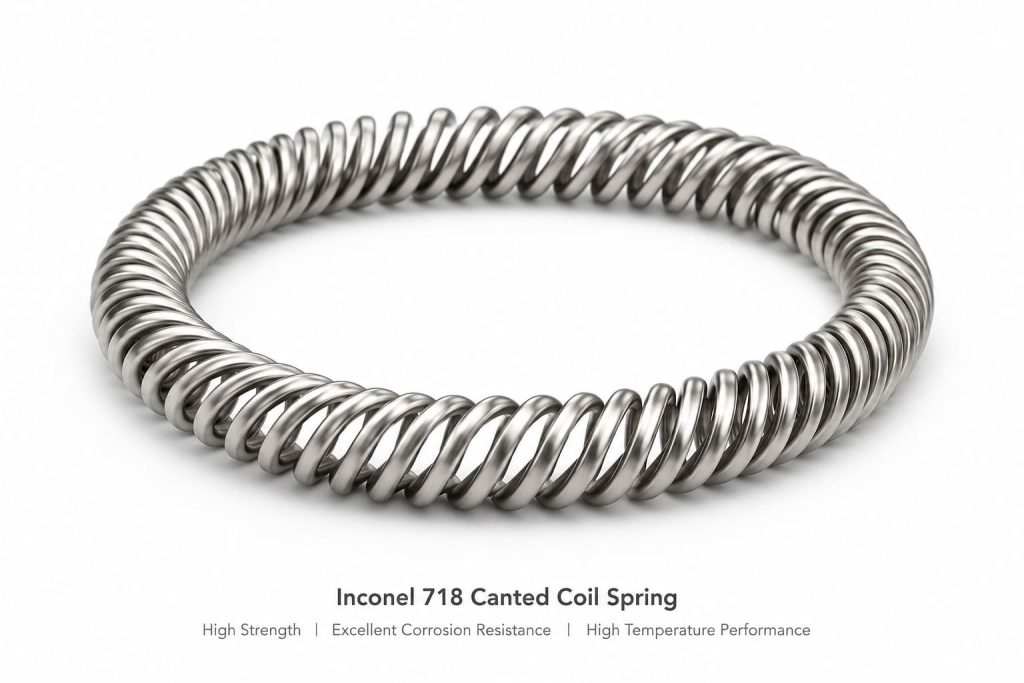
Many engineers have experienced the same situation:A sealing system performs well during room-temperature testing, but its sealing performance gradually deteriorates once it begins operating at elevated temperatures.The first assumption is often that the sealing material has degraded.
However, in many cases, the real issue lies in the Canted Coil Spring itself.As operating temperature increases, conventional spring materials may experience:
This ultimately leads to leaks—affecting the reliability of the equipment is seal.
In other words, the seal may still be in good condition, but the spring can no longer provide sufficient preload to maintain reliable sealing.This phenomenon is particularly common in high-temperature valves, aerospace hydraulic systems, oil and gas equipment, and chemical processing applications.
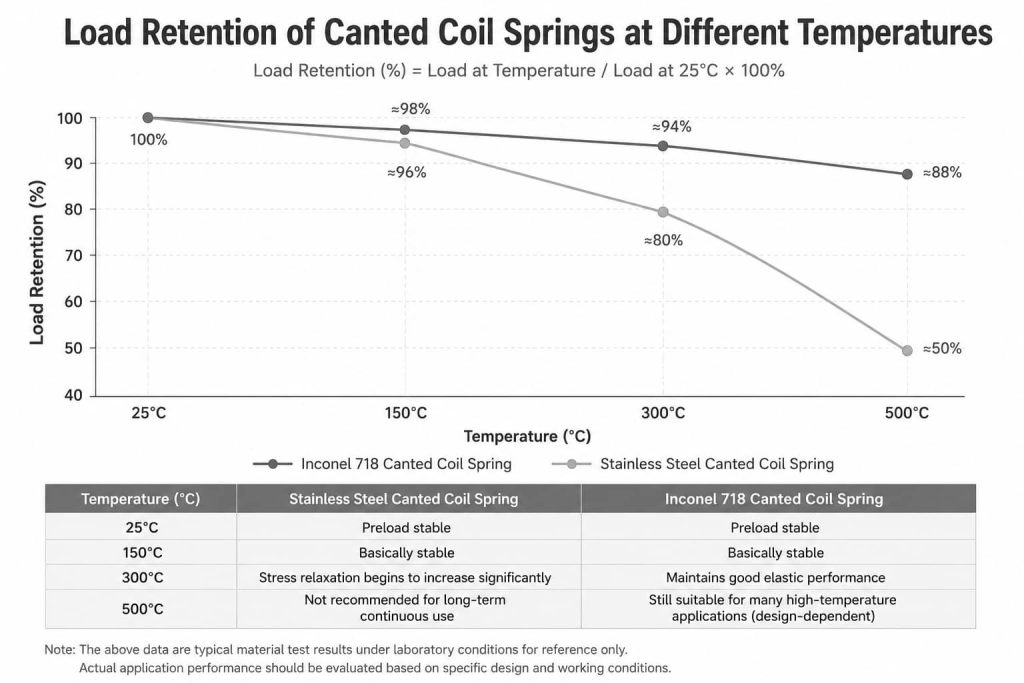
The following engineering reference illustrates how elevated temperature influences spring performance.
Reference Conditions
| Operating Temperature | Standard Stainless Steel Canted Coil Spring | Inconel® 718 Canted Coil Spring |
| 25°C | Stable preload | Stable preload |
| 150°C | Generally stable | Generally stable |
| 300°C | Noticeable increase in stress relaxation | Maintains stable elastic performance |
| 500°C | Generally not recommended for continuous service | Suitable for many high-temperature applications, depending on design conditions |
For design engineers, however, the more important question is:Why does it maintain reliable spring performance at elevated temperatures?
The answer lies in its metallurgical structure.
Inconel® 718 is a precipitation-hardened nickel-based superalloy. Its excellent high-temperature mechanical properties are achieved through strengthening precipitates (γ” and γ’ phases), allowing the material to retain strength and elasticity under elevated operating temperatures.Compared with conventional stainless steels, Inconel® 718 offers several engineering advantages:
In other words, the seal may still be in good condition, but the spring can no longer provide sufficient preload to maintain reliable sealing.This phenomenon is particularly common in high-temperature valves, aerospace hydraulic systems, oil and gas equipment, and chemical processing applications.
One of the most common questions engineers ask is:”Should I choose Inconel® 718, Elgiloy®, or 17-7PH Stainless Steel?”The answer depends entirely on the operating environment.Each material has its own strengths, and none should be considered universally superior.The following table summarizes their typical engineering characteristics.
Reference Sources: Special Metals Inconel 718 Technical Data, Elgiloy Material Datasheets, AK Steel 17-7PH Stainless Steel Datasheets, and other publicly available engineering references.
| Property | 17-7PH Stainless Steel | Elgiloy | Inconel 718 |
| Recommended Continuous Operating Temperature | Up to approximately 315°C | Up to approximately 450°C | Up to approximately 650°C |
| Corrosion Resistance |
Good |
Excellent |
Excellent |
| Stress Relaxation Resistance |
Good |
Excellent |
Excellent |
| High-Temperature Strength Retention | Moderate |
Very Good |
Excellent |
| High-Temperature Fatigue Resistance |
Good |
Excellent |
Excellent |
| Relative Material Cost |
Low |
High | very High |
Engineering Note: The recommended continuous operating temperatures shown above are general engineering guidelines rather than absolute material limits. Actual operating capability depends on heat treatment, applied load, service duration, environmental conditions, and overall system design.
The comparison clearly illustrates that:
Material selection should always be driven by application requirements—not simply by choosing the highest-grade alloy available.
Many engineers focus primarily on tensile strength when selecting spring materials.However, the long-term reliability of a Canted Coil Spring depends on several equally important factors:
Even the highest-performance alloy cannot compensate for poor system design.For this reason, experienced engineers evaluate the application first and the material second, rather than automatically selecting the most expensive alloy.
If you are unsure whether Inconel® 718 is the right material for your sealing application, our engineering team can help.Explore our products and technical resources:Canted Coil Spring SolutionsOur engineers can recommend the most suitable spring material and structural design based on your operating temperature, pressure, media compatibility, motion type, and expected service life.
After learning about the performance characteristics of Inconel® 718 Canted Coil Springs, many engineers ask the same question:If Inconel 718 performs so well, should every Canted Coil Spring be made from it?The answer is no.
Good engineering is not about choosing the most expensive material—it is about selecting the material that best matches the operating conditions.The ideal design balances performance, reliability, and cost.The following sections explain where an Inconel® 718 Canted Coil Spring provides real value and where other materials may be the better choice.
For applications operating under normal or moderately elevated temperatures, such as:
Standard sealing systems—most conventional packing seal applications
17-7PH Stainless Steel typically provides reliable spring force, good fatigue resistance, and excellent cost-effectiveness.In these applications, replacing it with Inconel® 718 rarely produces a significant improvement in service life but can substantially increase material costs.For most standard industrial sealing systems, optimizing groove design and spring deflection usually delivers greater performance improvements than upgrading the spring material.
As operating temperature increases, the challenges extend beyond mechanical strength.Engineers must also consider:
These are precisely the conditions where Inconel 718 Canted Coil Springs excel.Because the alloy retains excellent mechanical properties at elevated temperatures, it continues to provide stable preload even during long-term service.
Typical applications include:
Temperature is only one part of the equation.The operating media can have an equally significant impact on spring life.If a Canted Coil Spring is continuously exposed to:
corrosion resistance becomes a critical design consideration.Inconel 718 provides excellent overall corrosion resistance in many demanding environments.However, when corrosion resistance and resistance to stress relaxation are the primary concerns—and operating temperatures are relatively moderate—Elgiloy may also be an excellent engineering choice.
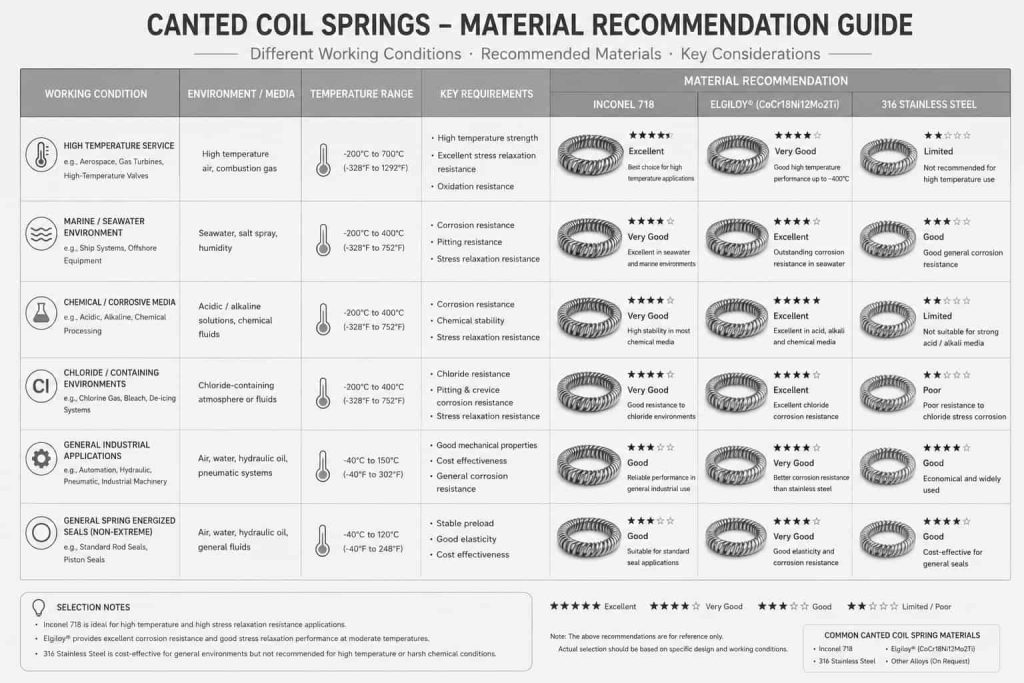
| Operating Environment | Recommended Material | Engineering Reason |
| General industrial automation | 17-7PH Stainless Steel | Balanced mechanical performance and cost |
| Standard hydraulic systems | 17-7PH Stainless Steel | Meets the requirements of most industrial applications |
| High-temperature sealing systems | Inconel 718 | Excellent load retention at elevated temperatures |
| Aerospace equipment | Inconel 718 | Outstanding high-temperature mechanical properties |
| Oil & Gas equipment | Inconel 718 | Combines heat resistance with corrosion resistance |
| Chemical processing equipment | Inconel 718 or Elgiloy | Selection depends on process media |
| Highly corrosive environments | Elgiloy |
Superior corrosion resistance and stress relaxation performance |
Engineering Note: The recommendations above are intended as general design guidance. Final material selection should always consider operating temperature, system pressure, media compatibility, compression ratio, groove geometry, and required service life.
Many engineers begin by comparing tensile strength or yield strength.While these properties are important, they do not determine the long-term reliability of a Canted Coil Spring by themselves.For example:
A sealing system operating continuously at approximately 80°C may show very little difference in service life between 17-7PH Stainless Steel and Inconel 718.
However, when the operating temperature approaches 500°C, stress relaxation in conventional stainless steel increases significantly, while Inconel 718 is able to maintain a much more stable spring load.This illustrates an important engineering principle:Material performance should always be evaluated within the actual operating environment—not in isolation.
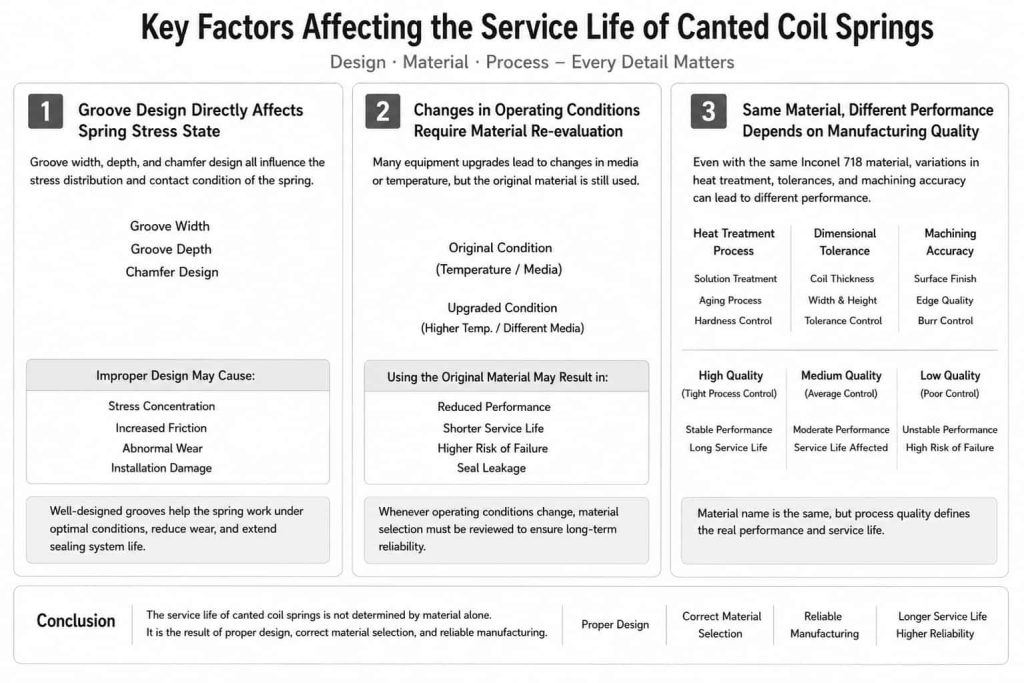
Many premature spring failures are not caused by the material itself.Instead, they are often related to design or installation issues.Before upgrading the spring alloy, engineers should also evaluate the following factors.
Excessive spring deflection increases internal stress, accelerates fatigue, and may result in permanent deformation.
Groove width, depth, and chamfer geometry all influence spring loading.Poor groove design can lead to:
Many systems are modified during their service life.Higher temperatures, different process media, or increased operating pressure may require a different spring material than the one originally specified.
| If Your Application Requires | Consider |
| Standard industrial service | 17-7PH Stainless Steel |
| Moderate temperatures with corrosive media | Elgiloy |
| Sustained high temperatures and heavy loads | Inconel 718 |
| Applications where downtime is extremely costly | Inconel 718 or Elgiloy, depending on operating conditions |
| Cost-sensitive industrial projects | 17-7PH Stainless Steel |
This table is intended as an initial selection guide only.Final material selection should always consider:
Is Inconel 718 always better than Elgiloy?Not necessarily.
For applications involving very high temperatures and heavy mechanical loads, Inconel® 718 is often the preferred solution.For applications where corrosion resistance, fatigue life, and resistance to stress relaxation are the primary concerns, Elgiloy® may offer better overall performance.
In most cases, no.For conventional hydraulic sealing applications operating at moderate temperatures, 17-7PH Stainless Steel is typically sufficient.Optimizing groove geometry and spring compression often provides greater benefits than selecting a higher-grade alloy.
Material is only one factor.Heat treatment, manufacturing precision, dimensional tolerances, surface finish, and production consistency all contribute to the final performance of a Canted Coil Spring.
An Inconel 718 Canted Coil Spring is not a universal solution for every application.Instead, it is a high-performance spring material specifically suited for high-temperature, high-load, and demanding service environments.Successful spring design depends on more than material selection alone.Groove geometry, compression ratio, operating conditions, and manufacturing quality all play equally important roles in achieving long-term sealing reliability.If you are developing a new spring-energized sealing system or optimizing an existing design, our engineering team is ready to help.Explore more technical resources:Contact Our Engineering Team
Our engineers can recommend the most suitable Canted Coil Spring material and design based on your operating temperature, media, pressure, motion type, and service-life requirements, helping you improve product reliability while reducing total lifecycle costs.
